
Home › Blog › What Is Security Film for Windows?
Safety & Security Film · Guide
What Is Security Film for Windows? How It Works, and What It Cannot Do
A plain guide to the clear film that holds broken glass together: what is inside it, what happens when the glass is hit, and where its limits are.
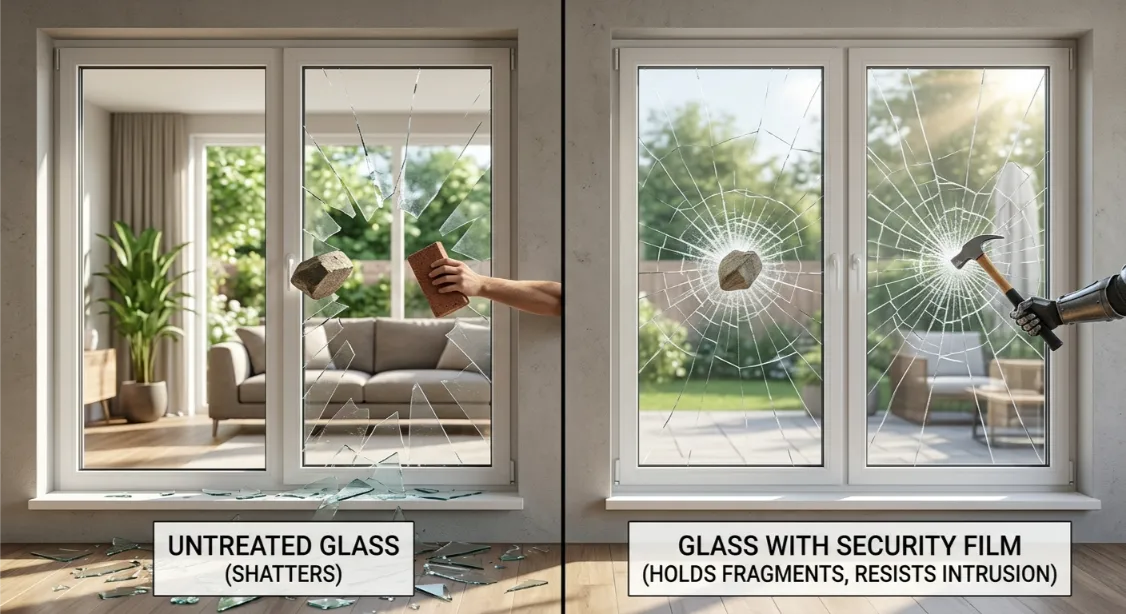
Security film for windows is a thick, clear polyester laminate bonded to the inside face of existing glass with a strong adhesive. It does not stop the glass from breaking. It holds the broken pieces together as one sheet, so the pane is harder to knock through, an intruder loses time and makes noise, and sharp fragments are far less likely to injure anyone in the room.
Most break-ins through glass, and most injuries from it, come down to the same weakness. An ordinary pane shatters into loose pieces with one hard blow, and the opening is there straight away.
Security film changes what happens after the glass breaks, not whether it breaks. Keep that in mind and the rest of this guide makes sense, including how to judge whether a film (and the way it is fitted) will deliver what the seller claims. If you are weighing a lighter safety grade against a heavier security grade, our guide to the difference between safety film and security film covers that choice. This page explains the product itself.
What a sheet of security film is made of
It is built in layers, and each one has a job. Reading from the room side towards the glass:
Scratch-resistant coating
Protects the exposed face from cleaning cloths, blinds and everyday contact.
Several layers of clear PET polyester
Tear-resistant polyester laminated into one thicker sheet. Total thickness is what separates security film from ordinary window film.
Bond between the plies
Holds the polyester layers together so they act as a single sheet under impact.
Pressure-sensitive adhesive
Grips the glass. This bond is what keeps broken fragments stuck in place.
The existing pane
Stays in its frame. The film is applied to it on site.
Thickness is quoted in mil. One mil is a thousandth of an inch, or 25.4 microns. Heat control and decorative films are thin. Security films are much thicker: the 8 mil and 12 mil grades Vision Guard fits work out at roughly 0.2 mm and 0.3 mm. That still sounds thin, but laminated polyester at that thickness is hard to tear, and it stretches under a blow instead of snapping.
What happens when filmed glass is hit
The glass still cracks, but the pieces stay stuck to the film instead of falling out or flying into the room.
Impact
The glass cracks, exactly as it would without film.
Fragments held
The mounting adhesive keeps the broken pieces bonded to the film.
Film stretches
The polyester plies take some of the force and resist tearing.
Time lost
Anyone forcing entry has to keep striking and cutting, which is slow and loud.
The weak point is the edge
Film applied only to the visible glass, known as a daylight application, stops a millimetre or two short of the frame. Under heavy, repeated force the whole cracked sheet can be pushed out of the frame in one piece. For doors, shopfronts and ground-floor glass, an attachment system closes that gap by bonding the film to the frame, usually with structural silicone along the edge or a mechanical strip fixed to the frame. Ask about edge attachment at the survey. It often decides whether a broken pane stays put or drops out whole.
What changes with security film, and what stays the same
| When the pane is struck hard | Plain glass | With security film |
|---|---|---|
| Does the glass break? | Yes | Yes |
| Broken pieces | Fall out or fly as sharp shards | Held together on the film |
| Opening to climb through | Can appear after one or two blows | Needs repeated strikes and cutting |
| Pane in the frame | Mostly gone | Stays, more firmly with edge attachment |
| How the window looks | Clear | Clear grades look almost the same |
| Heat and glare | Unchanged | Largely unchanged unless a tinted grade is chosen |
Where security film earns its place
It is most useful wherever glass is the easiest way in, or where broken glass would land near people:
- Ground-floor villa windows and sliding glass doors, which are often the softest entry point to a house.
- Shopfronts and showroom glazing, where a smash-and-grab depends on getting in and out in seconds.
- Office lobbies, glass partitions and meeting rooms, where the worry is staff and visitors near breaking glass.
- Schools, clinics and family homes, where accidental impact is a bigger risk than crime.
- Large panes exposed to wind-borne debris, where held fragments are safer than a shower of shards.
To see how Vision Guard surveys, specifies and fits it, read about our safety and security window film service. In the capital, our team covers security film for Riyadh offices and villas, with surveys also arranged in Diriyah and Al Kharj.
What security film cannot do
It delays and deters. It does not make glass unbreakable, bulletproof or the same as laminated glass.
It does not make glass unbreakable
The glass breaks. The film holds the pieces and slows down whoever is trying to get through.
It is not bullet or blast rated by default
Only specific films, tested to those standards and installed with the attachment system they were tested with, can claim that. Standard grades make no such claim.
It does not turn your glass into laminated glass
Film adds a layer to one face of existing glass. Laminated glass has its interlayer sealed between two panes at the factory, and the two behave differently. Our article on how film compares with laminated glass goes into the detail.
It is not a whole security system
Film buys time. Locks, alarms, lighting and cameras still do the rest of the job.
It is not right for every pane without a check
Some double-glazed, tinted or heat-treated units need a compatibility check before a thick film goes on, because film changes how the glass takes up heat. A proper survey covers this.
Is it the same as the tint already on my windows?
No. Tint is a thin film made to cut heat and glare. Security film is a much thicker laminate made to hold broken glass together, and tint on its own does very little when the glass is struck.
If your windows already have tint, the old film normally has to come off before the new one goes on, because the new adhesive needs clean glass to bond to. Where you want both jobs done on one window, ask whether a tinted security grade suits it.
Worth remembering
Film that looks the same on the glass can perform very differently. Thickness, adhesive and the way the edges are finished decide what happens on the day the glass is hit.
How to tell whether a film is really security film
Three questions separate a genuine security product from a thin film sold under the same name:
What is the thickness?
Ask for it in mil or microns. Thin decorative or heat films are not security film, whatever the label says.
Which impact test has it passed?
Recognised safety glazing tests include EN 12600 and ANSI Z97.1. Ask to see the report, not just the claim.
How will the edges be finished?
For doors and shopfronts, ask whether edge attachment is included and which method is used.
Written by Vision Guard. We survey and fit safety and security film in 8 mil and 12 mil grades on homes, shops and offices, from our base in Al Malaz, Riyadh. Our safety film is covered by a 10-year warranty on the film and its installation.
Frequently asked questions
Does security film make glass unbreakable?
No. Security film does not stop glass breaking. It holds the broken pieces together on the film, so the pane resists being knocked through and fragments do not scatter. It delays entry; it does not prevent it indefinitely.
Can you see security film once it is fitted?
Clear security grades are designed to be close to invisible once the film has dried in. Up close you may notice the narrow gap at the edge of the glass, or the attachment bead where edge attachment has been used.
How long does security film last?
Vision Guard covers its safety and security film with a 10-year warranty on the film and its installation. Real service life depends on how much direct sun the glass gets and how it is cleaned.
Can security film be fitted without replacing the windows?
Yes. The film is applied to the inside face of your existing glass on site, and the frames stay where they are. The film can look slightly hazy for a short time while the application water dries out; how long depends on temperature and film thickness.
Does security film work on double-glazed windows?
Usually, yes. It goes on the room-side face of the inner pane. The installer should check the glass unit first, because some double-glazed and tinted units need a compatibility check before a thick film is added.
Find out what your glass needs
Vision Guard surveys each window and door, then recommends a film grade and edge finish for every opening. Ask for a site survey, or send us photos of your glass on WhatsApp.