
Home › Blog › Smart Film Price in Saudi Arabia
Smart Film · Cost Guide
Smart Film Price in Saudi Arabia: What Drives the Cost per Square Metre
Smart film is quoted per square metre, but the rate on your quote depends on far more than the film. Here is every line that moves the price, so you can read a quote properly and compare like with like.
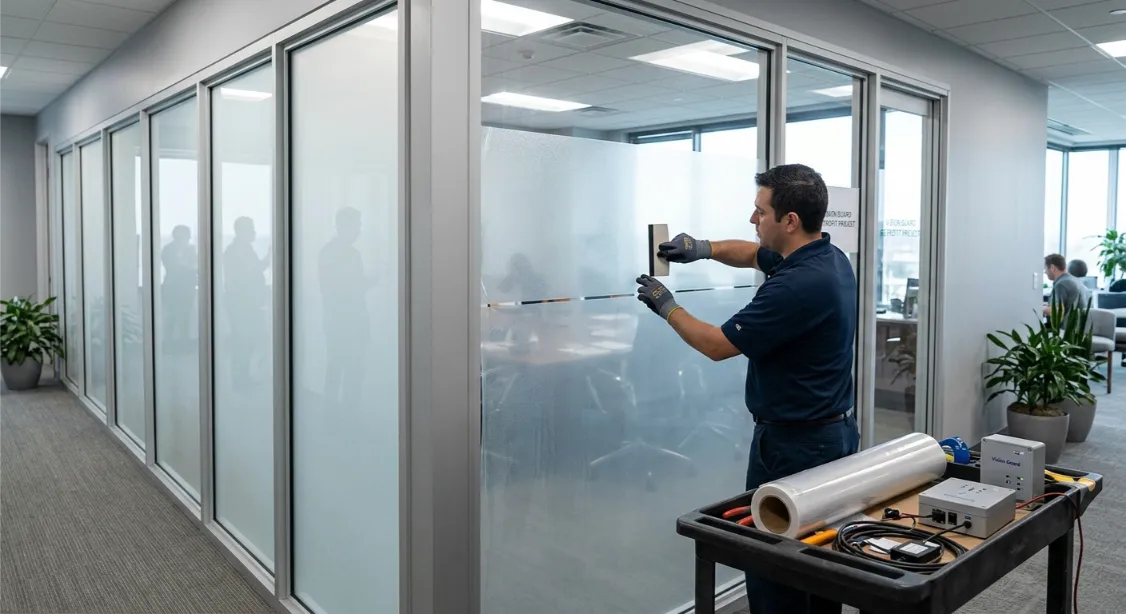
Smart film in Saudi Arabia is priced per square metre of glass covered. The installed rate depends mainly on how many separate panels the job needs, the control system, how the power is wired in, access height and the condition of the glass. The same area split across many small panes costs more per square metre than a few large ones, because every panel needs its own edge connection and fitting time. Vision Guard gives a fixed written quotation after a free site survey.
Vision Guard smart film pricing in Saudi Arabia starts from SAR 350 per square metre.
Most people start with one question: what does it cost per metre? At Vision Guard, smart film starts from SAR 350 per square metre, but that starting rate on its own tells you very little. Two jobs with identical glass area can be quoted very differently, and both quotes can be fair. The difference sits in how the area is divided, how the film is powered and controlled, and how much work happens before the film touches the glass.
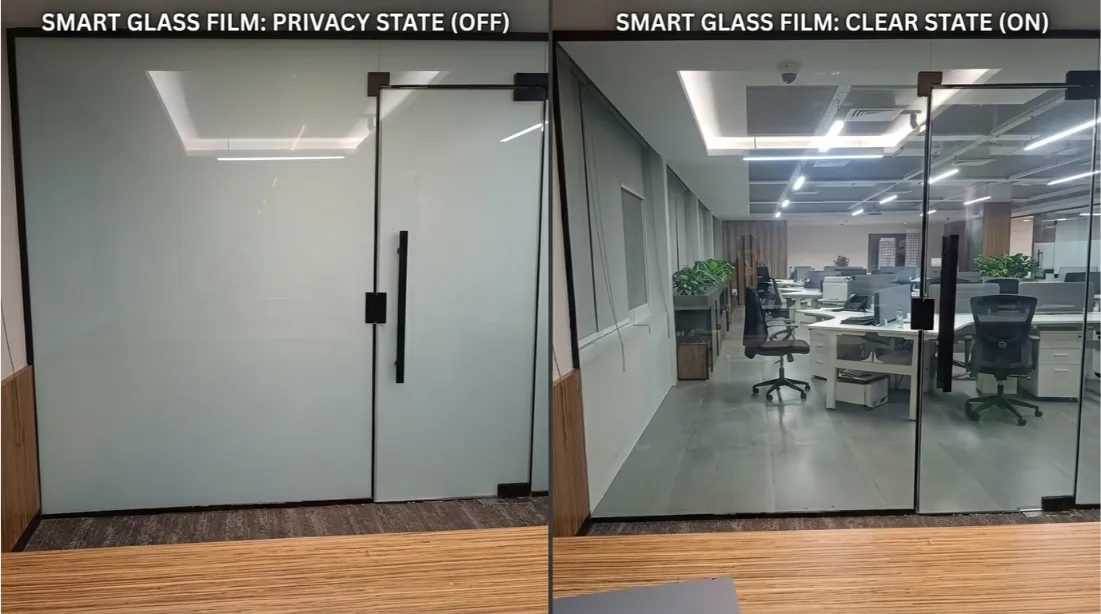
If the technology itself is new to you, our guide to how PDLC smart film switches between frosted and clear covers the basics. This article stays on cost.
What a Smart Film Quote Actually Covers
A complete quote for switchable film is built from six parts. If one is missing from a quote you receive, ask whether it is excluded or folded into the square-metre rate.
The film
PDLC film cut to the exact size of each pane. The standard colour is milky white. Grey and blue are made to order and can change the material cost.
Edge connections
Each panel needs a conductive strip, called a busbar, along one edge so power reaches the liquid crystal layer. This is charged per panel, not per square metre.
Power supply and controller
A transformer steps mains power down to the low voltage the film runs on, plus the control you choose: a wall switch, an RF remote, a smartphone app or Lutron integration. Bigger installations can need more than one power supply.
Wiring
Cable from each panel to the power supply, and from there to a mains point. Concealed runs through ceilings or partition frames take longer than surface runs.
Preparation and fitting
Deep cleaning, stripping any old film and its adhesive, then applying, connecting and testing every panel.
Access
A ladder covers most rooms. Double-height glass, atriums and upper-level shopfronts may need scaffolding or a lift.
Which Factors Move the Price Most
Some of these change the total a little. Others can change the rate per square metre considerably. This is how we would rank them from site experience.
| Cost driver | Why it changes the price | Effect on price |
|---|---|---|
| Number of panels | Each panel needs its own busbar, connection and fitting time | High |
| Glass beyond the film's size limits | Larger panes need two or more panels joined side by side | High |
| Control system | A wall switch costs less than remote, app or smart home control; separate zones need more hardware | Medium to high |
| Wiring route | Hidden cable through walls, ceilings or frames adds labour and sometimes carpentry | Medium |
| Access height | Scaffolding or a lift adds equipment and time | Medium, high for atriums |
| Removing old film | Existing tint or frosting and all adhesive must come off first | Low to medium |
| Glass and frame condition | Chips, scratches or frames tight against the glass slow preparation | Low to medium |
| Film colour | Grey and blue are made to order | Low to medium |
Why Panel Count Matters More Than Total Area
Take two meeting rooms with the same amount of glass. One has three tall panes. The other has twelve smaller panes in a framed grid. The second room needs four times the edge connections, four times the cutting and fitting, and more cable back to the power supply. Its rate per square metre will be higher, even though the area is identical.
Size limits add to this. Vision Guard's film comes in a maximum roll width of 1,500 mm and a maximum single panel length of 3,000 mm. Glass larger than that is covered with two panels side by side, with a fine joint between them.
One panel, one busbar, one connection.
Two panels, two busbars, a visible joint line.
The joint is worth discussing at the survey. Lining it up with a frame, a mullion or the centre of the pane keeps it discreet.
Self-Adhesive Film or Laminated Smart Glass?
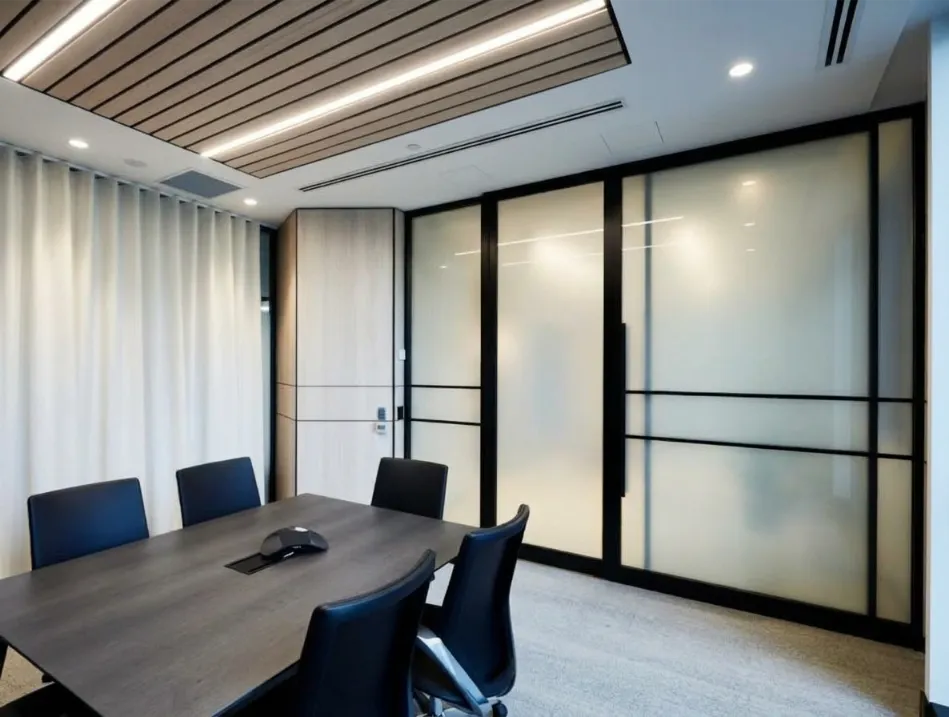
Self-adhesive smart film is the lower-cost route for most existing buildings. It is applied to the glass you already have, so you pay for the film, the power system and the fitting. Laminated smart glass seals the PDLC layer between two sheets of glass at the factory, which means paying for new glass, a fabrication lead time and removal of the old panes.
Laminated glass mostly makes sense in new builds, or where glass is being replaced anyway. For a fit-out or renovation, film does the same job on the glass that is already there.
What Smart Film Costs to Run
Very little. Vision Guard's film draws around 4 to 6 watts per square metre while clear and nothing while frosted, so a 10 m² partition uses less power than a standard light fixture. Electricity is rarely worth budgeting for. The parts that matter long term are the transformer and controller, so check what the warranty says about them as well as the film. Vision Guard's smart film carries a 2-year warranty.
Before you compare prices
A low rate per square metre with no panel count, controller or wiring listed cannot be compared with a fully itemised quote. Ask for the missing lines first, then compare.
How to Compare Two Smart Film Quotes
Put the quotes side by side and check each point below. Most price gaps between suppliers trace back to one of them.
- Panel count: both quotes should list the same panes and the number of panels, not just total square metres.
- Joint positions: for any glass over 1,500 mm wide, where the joint will sit.
- Control system: switch, remote or app, and how many zones can be switched separately.
- Wiring scope: concealed or surface cable, and who provides the mains connection.
- Preparation: whether removing old film and residue is included.
- Access: whether scaffolding or a lift is priced in for high glass.
- VAT: whether the 15% VAT is shown separately or already included.
- Warranty: how long it runs and whether it covers film, power supply and workmanship.
Getting an Accurate Price
Vision Guard quotes after a free site survey. We measure every pane, check the glass and frames, find the nearest power point, and agree the control system and joint positions with you before anything is priced. The result is a fixed written quotation, so the number you approve is the number you pay.
You can speed things up by sending photos of the glass, rough sizes, the rooms involved and how you would like to switch the film. The full specification sheet, including thickness and adhesive type, is on our smart film installation page. We install across Saudi Arabia, including Riyadh, Jeddah, Dammam, Al Khobar, Makkah, Madinah, Tabuk and Khamis Mushayt.
Frequently Asked Questions
Can I cover only part of the glass to reduce the cost?
Yes. A privacy band at eye level uses less film than covering the full pane, which lowers the material cost. Each separate piece still needs its own edge connection and wiring, so the saving is smaller than the drop in area suggests.
Is it cheaper to install smart film during construction or a fit-out?
Usually, yes. Before ceilings and partitions are closed, cable can be routed out of sight with far less work. Fitting into a finished room often means surface trunking or opening up walls and ceilings.
Does smart film work with home or building automation, and does that cost more?
Yes. Vision Guard can wire smart film into Lutron systems, so the glass shares the same keypads and scenes as your lighting and shades. Timers, occupancy sensors and door-contact triggers can be added too, for example a bathroom that turns private when the door closes. This costs more than a wall switch or RF remote because it needs extra control hardware and programming.
Do I pay for the site survey?
No. The survey is free and the written quotation that follows carries no obligation to go ahead.
Get a Fixed Price for Your Glass
Book a free site survey and receive an itemised quotation with every panel, control and wiring line listed.