
Home › Blog › PDLC vs SPD vs Electrochromic Glass
Smart Glass · Buyer's Guide
PDLC vs SPD vs Electrochromic Glass: Which Switchable Glass Fits Your Project?
All three are sold as "smart glass", yet they solve different problems. One gives you privacy, the other two give you shade. Here is how to tell them apart before you specify anything.
PDLC smart glass switches between frosted and clear, so it is the choice when you need privacy. SPD and electrochromic glass switch between dark and clear, so they control sunlight and glare but do not hide what is behind the glass. PDLC and SPD change in milliseconds to seconds, while electrochromic glass takes minutes. PDLC is also the only one of the three widely available as a film that is fitted to glass you already have.
If you have been comparing smart glass suppliers, you have probably noticed that each one tends to recommend the technology it happens to make. That makes a straight comparison hard to find. This guide sets the three technologies side by side, explains what each is genuinely good at, and shows where each one falls short in a Saudi home, office or commercial building.
Do You Need Privacy or Shade?
Answer that first and most of the decision makes itself.
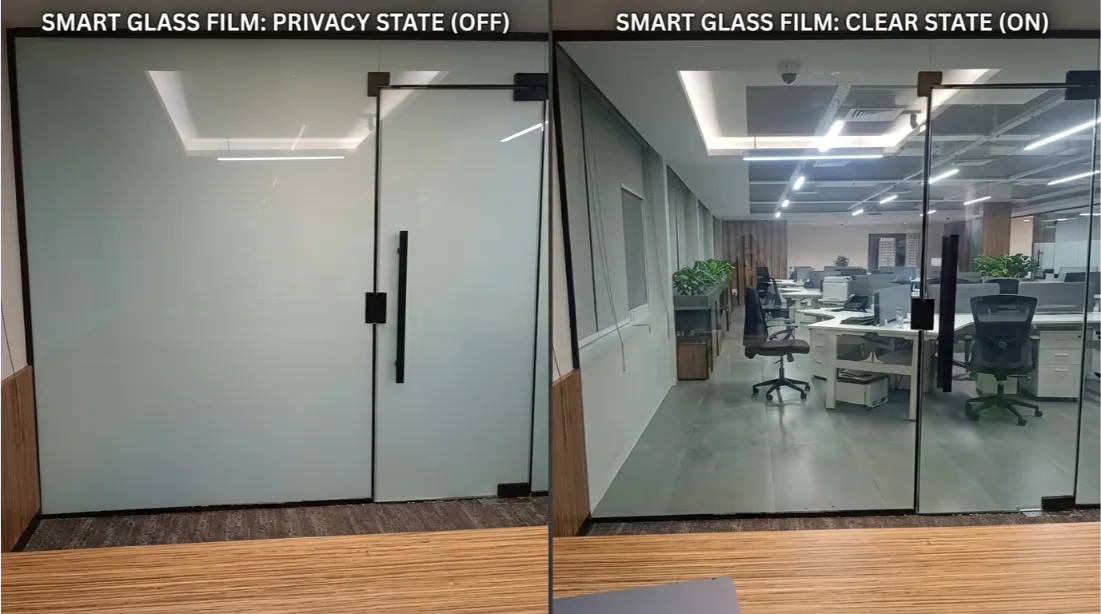
PDLC works by scattering light. When it is switched off, tiny liquid crystal droplets point in random directions and bounce light around, which turns the glass milky white. You cannot see shapes through it, but daylight still passes into the room.
SPD and electrochromic glass work by absorbing light. When they darken, they behave more like sunglasses than a frosted screen. The room gets dimmer and cooler, but a person standing close to the glass can usually still see through it, especially at night when the inside is lit.
The same view through each technology in its "closed" state. Only PDLC hides the figure completely.
So a meeting room, a bathroom window or a street-facing majlis needs PDLC. A skylight, an atrium roof or a sun-baked facade where the goal is glare and heat control is where SPD or electrochromic glass earns its place.
PDLC, SPD and Electrochromic Glass Compared
| Feature | PDLC | SPD | Electrochromic |
|---|---|---|---|
| What it does to light | Scatters it (frosted) | Absorbs it (darkens) | Absorbs it (tints) |
| Main purpose | Privacy on demand | Adjustable shading | Solar and glare control |
| State with no power | Frosted | Dark | Stays in its last state |
| Switching time | Milliseconds | A few seconds | Minutes, slower on large panes |
| Settings | Clear or frosted | Dimmable across a range | Dimmable across a range |
| Power to hold clear state | Continuous | Continuous | Very little |
| Hides people and objects | Yes | Not fully | No |
| Fits existing glass as a film | Yes, self-adhesive film | Usually built into new glass | Built into new glazing units |
| Typical uses | Partitions, meeting rooms, bathrooms, villa windows | Skylights, aircraft windows, shading roofs | Building facades, skylights |
Switching times and power behaviour vary by manufacturer, so always check the data sheet for the exact product being quoted.
PDLC: Privacy at the Flick of a Switch
PDLC (polymer dispersed liquid crystal) is the technology most people picture when they hear "smart glass". Apply power and the crystals line up so the glass goes clear. Cut the power and it returns to frosted almost instantly. If you want the full science, our explainer on how switchable smart glass works covers the layers and the electrics step by step.
Three practical points matter when choosing it:
- It fails private. During a power cut the glass goes frosted, not clear. For a bathroom or a consultation room that is exactly what you want.
- It has two settings, not a dimmer. PDLC is designed for clear or frosted. If you want to dial light levels up and down, that is SPD or electrochromic territory.
- The clear state has a slight haze. It is transparent, but not quite as crisp as plain glass. Most people stop noticing within a day; a design team specifying a feature window should see a sample first.
PDLC is not primarily a heat control product. Its job is privacy. When a room also takes strong direct sun, the usual approach is to pair it with a dedicated sun control window film on the exposed glass.
SPD: Dimmable Tint, Not a Privacy Screen
SPD (suspended particle device) glass contains microscopic rod-shaped particles held in a liquid layer. Without power they sit at random angles and block most of the light, so the glass looks dark. Apply voltage and they line up, letting light through. Vary the voltage and you get every shade in between.
That fine control is SPD's strength. It makes sense on a skylight over a living area or a glass roof where you want to cut glare at midday and let light back in during the late afternoon.
The trade-offs are worth knowing. The default state is dark, so a power failure leaves the room dim. The dark state often carries a bluish cast. And because it absorbs rather than scatters light, a darkened SPD pane does not give the solid visual privacy people expect from "privacy glass". SPD is also normally laminated inside new glass rather than applied to existing windows.
Electrochromic Glass: Slow, Efficient Facade Glazing
Electrochromic glass tints through a small electrochemical reaction. A low voltage moves ions between thin coatings on the glass, and those coatings darken. Reverse the voltage and they clear again.
Its big advantage is efficiency. Once it reaches a tint level it holds that state with very little power, which is why it appears on large commercial facades where solar control across a whole building matters.
The catch is speed. Electrochromic panes typically take several minutes to fully tint or clear, and larger panes take longer. Like SPD, the tinted state often has a blue colour, and it does not hide people or objects. It is manufactured into sealed insulated glass units, so adopting it means replacing the glazing, which is usually only practical on a new build or a full facade renovation.
Key point
If the brief says "privacy", the answer is almost always PDLC. If the brief says "glare" or "solar control" on new glazing, SPD or electrochromic glass may fit. If it says both, the practical answer is usually PDLC film for privacy plus a sun control film for heat.
Which Technology Suits Which Space?
Office meeting rooms and partitions
Open and bright between meetings, fully private during them. Film fits existing partition glass.
Bathrooms and en-suites
Fails to frosted, which is the safe default. Laminated glass is the better format inside wet shower zones.
Villa majlis and street-facing windows
Privacy from the street without curtains, with the view back whenever you want it.
Clinic and consultation rooms
Curtain-free privacy that switches in an instant and wipes clean.
Skylights and atrium roofs
Where the aim is dimming overhead sun rather than blocking a view, adjustable tint makes sense.
New-build facades
Worth considering when glazing is being specified from scratch and the budget allows factory-made smart units.
Why Retrofit PDLC Film Suits Most Saudi Projects
Most privacy requests we receive come from buildings that are already glazed: a villa that has just been finished, an office floor being refitted, a clinic moving into leased space. In those situations, replacing the glass to install SPD or electrochromic units means removing frames, lead times on custom glazing and a far larger budget.
Self-adhesive PDLC film avoids all of that. It is cut to each pane, applied on site to the existing glass and wired to a transformer and controller, usually without taking a single window out. For the privacy problems that dominate Saudi homes and workplaces, from majlis windows to glass-walled meeting rooms, that is the most direct route.
There is a fair limit to this. If a project genuinely needs variable dimming on a skylight or a facade, PDLC is the wrong product, and it is better to say so at the survey stage than after installation. You can see the film types, applications and warranty on our smart film installation service page.
Questions to Ask Any Supplier Before You Choose
- What does the glass look like with the power off, and is that acceptable in this room?
- How long does it take to switch fully, and does that depend on pane size?
- Is the product a film for existing glass or a new laminated or insulated unit?
- What are the haze and light transmission figures in the clear state, from the data sheet?
- What does the warranty cover: the film, the controller, the installation, or all three?
Written by Vision Guard. We survey and install switchable PDLC smart film for homes, offices and commercial projects across Saudi Arabia.
Frequently Asked Questions
Which smart glass gives privacy when the power goes off?
PDLC. It returns to its frosted state whenever power is removed, so the room stays private. SPD goes dark but not fully opaque, and electrochromic glass simply stays at whatever tint it had before.
Can PDLC smart film be dimmed like SPD glass?
Not in the same way. PDLC is designed to switch between clear and frosted. If you need to adjust light levels gradually, SPD or electrochromic glass is the better fit, or you can pair PDLC with a fixed tint window film.
Can SPD or electrochromic glass be added to my existing windows?
Generally no. Both are normally manufactured into new laminated or insulated glass units, so the existing glazing has to be replaced. PDLC is the one widely available as a self-adhesive film applied to glass already in place.
Does PDLC smart film reduce heat?
Its main role is privacy, not solar control. It will soften direct sun when frosted, but for meaningful heat rejection on sun-facing glass, a dedicated sun control window film does that job far better.
Not Sure Which Smart Glass You Need?
Tell us about the room and what you want the glass to do. Vision Guard will survey the space and recommend the right option, including when PDLC is not the answer.