
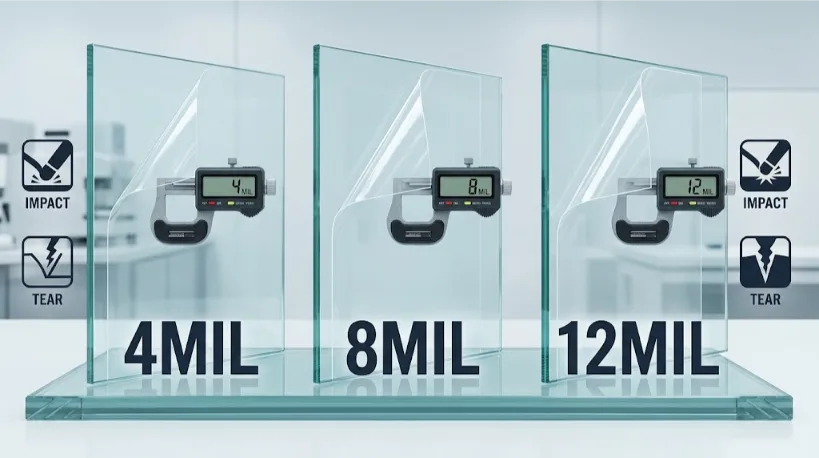
Most homes need 4 mil safety film. Shops, schools and ground-floor offices usually need 8 mil. 12 mil is the strongest clear grade, with almost three times the break strength of 4 mil, for glass that takes the most risk. If your glass also lets in too much heat, an 8 mil nano ceramic grade does both jobs.
The right grade depends on three things: what you are protecting against, the size and type of your glass, and which side of the glass the film goes on. This guide walks through each thickness with the numbers from our data sheets.
If you are still deciding whether you need safety film at all, start with our guide on what security film for windows is and how it works. This page is about choosing the grade.
What "mil" means
A mil is one thousandth of an inch, or 25.4 microns. It measures the film, not the glass.
Homes, villas, interior glass, accidental breakage.
Shopfronts, schools, clinics, ground-floor offices.
High-value shopfronts, banks, reception and cash areas.
Thicker film holds broken glass together more strongly and is harder to tear through. It does not turn ordinary glass into bulletproof or blast-proof glass.
How the three grades compare
| Property | 4 mil clear | 8 mil clear | 12 mil clear |
|---|---|---|---|
| Layers | 1 or 2 | 2 | 2 |
| Visible light transmission | 87–90% | 89% | 88% |
| UV transmission | Under 5% | Under 1% | Under 1% |
| Total solar energy rejected | 12–18% | 16% | 17% |
| Break strength (lbs/in) | 100–130 | 220 | 340 |
| Tensile strength (PSI) | 14,000–18,000 | 28,446 | 28,446 |
| Peel strength (g/in) | 1,200–1,800 | 2,200 | 2,000 |
| Fitted on | Inside of glass | Outside of glass | Inside of glass |
| Fire rating | ASTM E-84 Class A | ASTM E-84 Class A | ASTM E-84 Class A |
Figures measured on 3 mm clear glass, from Vision Guard product data sheets. 4 mil values are approximate ranges.
Thicker means stronger, not cooler
All three clear grades let in about the same daylight and reject about the same heat (12–17%). What you pay for with a thicker film is strength. If heat is your problem, see the nano ceramic option below.
4 mil safety film: for homes and everyday accidents
4 mil is the entry grade. Its main job is to hold the pieces together when glass breaks, so nobody gets hurt by falling shards. It keeps 87–90% of daylight, so rooms stay bright.
It suits:
- Sliding doors and large windows in villas
- Glass near children's play areas
- Interior glass doors and partitions
- Majlis and living room glass that faces a garden or street
What it will not do is stop someone who is determined to get in. A thin film slows a break-in very little. If security is your main worry, look at 8 mil or more.
8 mil security film: the commercial all-rounder
8 mil is a two-layer film with about twice the break strength of 4 mil (220 lbs/in against 100–130). It holds broken glass more firmly and makes the pane harder to push through, which helps against a quick smash-and-grab.
Our 8 mil clear grade is made for the outside face of the glass. That is useful where the inside is hard to reach, such as shopfronts with fixed displays behind them. For shop owners, our guide to security film for shops explains what film stops in a smash-and-grab.
It suits:
- Shopfronts and showroom glass in malls and high streets
- Schools, nurseries and clinics, where broken glass is a serious risk
- Ground-floor offices and reception areas
- Villa doors and windows that are easy to reach from outside
For most shops, schools and offices, 8 mil is the sensible balance between protection, clarity and cost.
12 mil security film: the strongest clear grade
12 mil film has the highest break strength of the three: 340 lbs/in, against 220 for 8 mil. It still lets 88% of daylight through, so the glass looks almost untreated. It is fitted on the inside face of the glass.
It suits glass where a breakage would be costly: jewellery and electronics shopfronts, bank and cash counters, server rooms, and large ground-floor panes in offices and showrooms.
Need heat control as well? The 8 mil nano ceramic option
Clear safety film rejects only about 16% of solar heat. Our Nano Ceramic 70100 film is also 8 mil thick and holds broken glass together, but it rejects far more heat. The trade-off is a slightly darker look.
| 8 mil film | Clear safety film | Nano Ceramic 70100 |
|---|---|---|
| Holds broken glass together | Yes | Yes |
| Heat rejected | 16% | 60–70% |
| Visible light transmission | 89% | 69% |
| Haze | Low | 0.42% |
| Signal interference (phone, GPS, Wi-Fi) | None | None |
It suits west- and south-facing glass in Riyadh villas and offices, where the afternoon sun is the bigger daily problem and breakage is the second worry.
Thickness is only part of the decision
Two films with the same mil number can perform very differently. Before you choose, check these four points:
Break and tensile strength
These numbers, not the mil figure alone, tell you how hard the film is to tear. Ask for the data sheet.
Which side it goes on
Some grades are made for the outside face of the glass, others for the inside. The wrong side shortens the film's life.
Your glass
Single, tempered, laminated and double-glazed units behave differently. Large or tinted double-glazed panes need checking for heat stress.
Heat control
Clear safety films reject 12–17% of solar heat. If heat is a problem, a nano ceramic safety grade does both jobs.
Which thickness fits your property?
| Property | Main risk | Usually recommended |
|---|---|---|
| Villa or apartment | Accidental breakage, children | 4 mil |
| Villa with sunny west or south glass | Heat plus breakage | 8 mil Nano Ceramic 70100 |
| Villa with easy-access ground-floor glass | Break-in | 8 mil |
| School, nursery, clinic, hospital | Injury from broken glass | 8 mil |
| Shop, showroom, mall unit | Smash-and-grab | 8 mil, or 12 mil for high-value stock |
| Office reception, ground floor | Break-in, vandalism | 8 mil |
| Jewellery, bank counter, server room | Forced entry | 12 mil |
This is a starting point, not a final specification. A site survey confirms the glass type, frame and sun exposure before we recommend a grade.
What no thickness can do
Safety film adds strength and keeps shards together. It is a second line of defence, not a replacement for security glazing.
It is not bulletproof or blast-proof
At 4, 8 or 12 mil, the film will not stop bullets and does not provide blast protection. Premises that need either require certified security glazing, and we will tell you so during the survey.
The edge is the weak point
The film is trimmed to within about 3 mm (1/8 inch) of the frame. It holds the broken pieces together, but a hard enough hit can push the whole filmed pane out in one piece.
It is not the same as laminated glass
Film adds a layer to one face of existing glass. Our guide on safety film vs laminated glass explains how the two differ.
What happens during a Vision Guard site survey
Check the glass
Glass type, size, frame condition and which way it faces.
Understand the risk
Accidents, break-ins, heat, or a mix of all three.
Recommend a grade
We show you the data sheet for the film we suggest.
Written quote
Film name, grade and warranty, in writing.
Install and cure
The film may look slightly hazy for up to 30 days while it dries.
Get the right film the first time
Paying for 12 mil where 4 mil is enough wastes money. Fitting 4 mil on a shopfront leaves you exposed. A short survey avoids both mistakes. See our safety and security window film service, or if your property is in the capital, our security and safety film installation in Riyadh.
Frequently asked questions
Does thicker safety film make glass bulletproof?
No. Even 12 mil film only holds broken glass together and makes it harder to push through. Bullet-resistant glazing is a separate, certified product.
Will 8 or 12 mil film make my room darker?
No. Our clear grades let through 87–90% (4 mil), 89% (8 mil) and 88% (12 mil) of visible light, so most people cannot tell the film is there. The Nano Ceramic 70100 safety grade is darker at 69%, because it also blocks heat.
Can safety film go on double-glazed windows?
Usually yes, but we check the glass first. Large or tinted double-glazed units can crack from heat stress if the wrong film is used.
Is safety film fire rated?
Yes. Our clear 4, 8 and 12 mil grades meet ASTM E-84 Class A for flame spread and smoke development.
Does safety film block UV?
Yes. The 8 and 12 mil grades let through less than 1% of UV, and 4 mil less than 5%, which helps stop furniture and flooring from fading.
How much does safety film cost in Riyadh?
Price depends on thickness, total glass area and access height. We give a written quote after the site survey.
When can I clean the film after installation?
Wait 30 days. The film can look slightly hazy while moisture dries out. After that, use a soft cloth or sponge and normal glass cleaner, never abrasive cleaners or bristle brushes.
Not sure which thickness you need?
Vision Guard surveys each window and door, then recommends a film grade for every opening. Ask for a site survey, or send us photos of your glass on WhatsApp.