
Vision Guard · Makkah, Western Region
Glass breaks. Safety film decides what happens next. Vision Guard applies 4 mil, 8 mil and 12 mil safety and security film to hotel, apartment and commercial glazing across Makkah, so a broken pane stays in its frame instead of falling into a crowded lobby or onto a pavement below.
What the film actually does
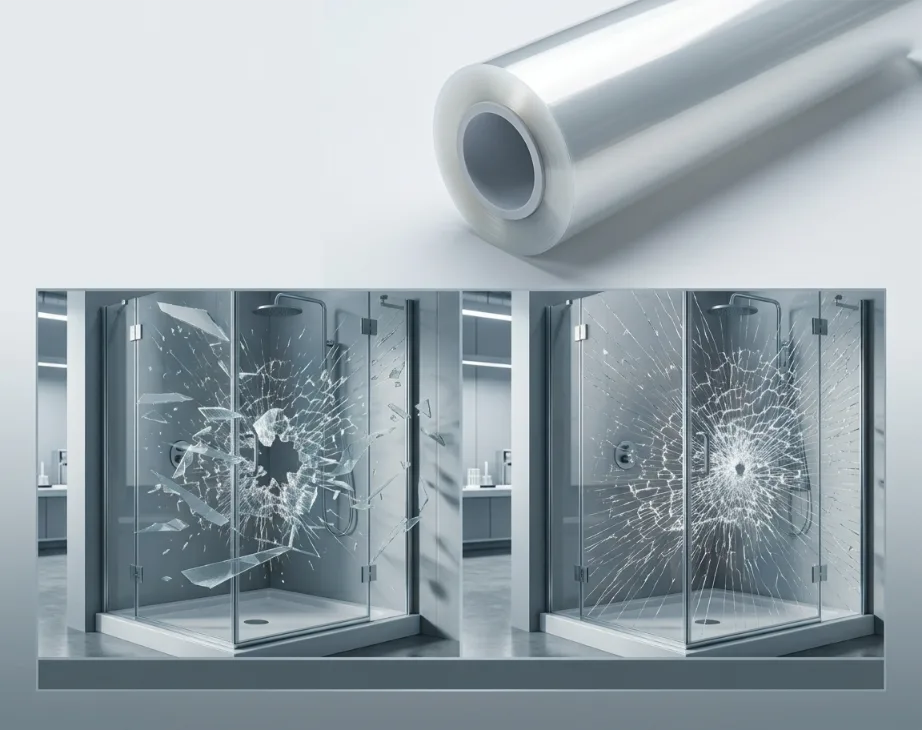
Security and safety film is a clear polyester laminate bonded to the inner face of existing glass. On its own, annealed glass fails into long shards. With film applied, the broken pane holds together as a single sheet against the adhesive layer, so the glass stays in the opening long enough for an area to be cleared and the pane replaced.
That one behaviour is what makes it relevant to buildings in Makkah. The risk in a hotel lobby, a prayer hall entrance or a ground floor shopfront is rarely the cost of the pane. It is a crowd standing next to it. Film does not stop glass breaking. It changes a falling-glass incident into a cracked-pane incident.
The film is optically clear, so a lobby fitted today looks the same tomorrow. For a wider explanation of grades, test behaviour and where each one is specified, see our safety and security window film service.
Full-height glass beside walkways, stairs and landings
Glass doors, sidelights and revolving door surrounds
Balustrades and glass panels on upper floors
Large panes with a low bottom edge near a walking surface
Ground floor shopfronts facing a busy street
Bathroom and wet area glazing in guest rooms
Why it matters here
Six reasons hotel operators and building managers in Makkah put safety film near the top of the list.
Hotels, serviced apartments and retail around the central area run close to capacity for much of the year. Any glass at street or lobby level is in contact with people all day.
Makkah is built into a narrow valley, so towers sit on slopes above streets and walkways. Glass that fails at height has somewhere to fall, and the film is what prevents that.
Smash-and-grab entry through a shopfront takes seconds through bare glass. Filmed glass holds together under repeated blows, which makes the attempt slower and louder than it would be through bare glass.
Film is applied to the glass already installed. There is no scaffolding programme, no removal of frames and no procurement lead time on replacement panes.
Most buildings in Makkah cannot close. Installation runs floor by floor, room by room or overnight, so rooms and units return to service the same day.
Clear safety film leaves the facade and the interior looking unchanged. Nothing about the building reads as retrofitted or hardened.
Choosing a grade
Thickness is the main variable in safety film. Thicker film holds more glass weight and takes more impact energy before it tears, so the grade follows the risk on that specific pane rather than the building as a whole. We stock three.
| Grade | Typical use in Makkah | Chosen when |
|---|---|---|
| 4 mil | Internal partitions, glass doors between rooms, bathroom and shower screens, low-level panes in private areas | The only concern is holding fragments together if the pane is knocked or breaks in use |
| 8 mil | Guest room glazing, office and clinic glass, apartment windows, upper floor panes away from public walkways | The concern is accidental impact and glass falling inside an occupied room |
| 12 mil | Lobby and entrance glass, ground floor shopfronts, large panes facing pavements and queuing areas, display glazing | The glass is public facing, large, or exposed to deliberate force as well as accidental impact |
A single building usually takes more than one. It is common to specify 12 mil across the ground floor and entrance, 8 mil through the guest floors above, and 4 mil on internal partitions and bathroom glass where nothing more is needed. The survey records the grade per elevation and per pane type so the quotation is itemised rather than averaged.
Buildings we work on
The specification changes with the building. These are the property types we are most often called to in Makkah.
Lobby glazing, restaurant frontage, guest room windows and bathroom glass, phased so rooms stay sellable.
Entrance halls, stair and corridor glazing, balcony panels and apartment windows on upper floors.
Street-level display glass where both accidental impact and forced entry are realistic concerns.
Glass partitions, meeting room walls and full-height perimeter glazing in open plan floors.
Reception screens, corridor glazing and door panels in areas with continuous patient movement.
Classroom doors, corridor glass and low-level glazing in areas used by children.
Survey and quote by zone, so the work can be released in stages rather than all at once
Night and early morning shifts where lobby or restaurant glass is involved
Sheeting and containment around the work area, with the floor left clean at the end of each shift
Guest rooms completed and handed back within the same day wherever the schedule allows
Team details and shift times supplied in advance for building access approval
Programming the work
Makkah rarely has a quiet month. Umrah traffic runs through the year and the Hajj period concentrates demand further, so the useful question on most sites is not how long the job takes but when it can happen without taking rooms or floors offline.
We plan around that from the survey onwards. Work is divided into zones, priced per zone, and scheduled in the windows the building gives us. Film cures over a short period after application, during which minor haze and moisture pockets are normal and clear on their own, so we set expectations with the operations team before the first shift rather than fielding questions afterwards.
Where a building also wants switchable privacy on meeting rooms or suites, that is a separate product and a separate survey. Our switchable privacy glass work in the city is often specified on the same project, but it is quoted on its own.
How it runs
Five stages, with the grade decision made on site rather than over the phone.
We walk the building, record pane sizes, glass type and risk per elevation.
4, 8 or 12 mil assigned per zone, with an itemised written quotation.
Shift times, zones and team details agreed with building management.
Glass cleaned and prepared, film applied and squeegeed, area left clean.
Zone-by-zone inspection, care guidance and the 10-year warranty issued.
Coverage
Vision Guard surveys and installs security and safety film across Makkah city and the surrounding district, including:
If your building sits outside these districts, the survey is still free. Tell us the address and the glass areas you are concerned about and we will confirm a visit.
Working with Vision Guard
Safety film is a core line, not a sideline. It is one of our main architectural services, with 4 mil, 8 mil and 12 mil held as standard grades.
Our own installation teams. The people who survey the building are the people who fit the film. No subcontracted crews.
10-year warranty. Covering both the film and the installation, issued at handover.
Itemised quotations. Priced by zone, grade and pane count, so you can release the work in stages.
Experience in live buildings. Hotels, towers and retail that cannot close during the work.
Arabic and English. Surveys, quotations and site coordination handled in either language.
Questions we get asked
Yes. Vision Guard installs 4 mil, 8 mil and 12 mil safety and security film on hotel and apartment glazing throughout Makkah, including lobby and entrance glass, restaurant frontage, corridor and stair glazing, guest room windows and bathroom panels. The film holds broken glass in the frame instead of letting it fall, which is the main reason it is specified in buildings with constant public footfall. Grade is assigned per zone during the survey.
Yes, and most of our hotel work is done this way. The job is divided into zones and priced per zone, so floors are released for work in stages rather than closed together. Lobby, restaurant and other public glass is usually handled on night or early morning shifts, while guest rooms are completed and handed back the same day wherever the schedule allows. The work area is sheeted and cleaned at the end of every shift.
Safety film is applied to the inside face of existing glass and changes nothing structural, so it does not normally involve municipal approval in the way a facade alteration would. What it does need is building-level permission: access approval from the owner or facility management, agreed shift times, and team details submitted in advance for site passes. Where a building sits within a managed complex, the complex operator may also have its own contractor induction. We supply the documentation requested and work to whatever access rules the building sets.
No. Standard security and safety film is optically clear, so a filmed facade looks the same as it did before from both outside and inside. There is no mirror effect, no tint and no visible edge once the film is trimmed to the glass. If a darker or more reflective appearance is wanted for heat or privacy reasons, that is a different product and would be surveyed separately.
They describe the same family of product at different weights. Thinner grades such as 4 mil are specified mainly to hold broken glass together so fragments do not fall, which is the safety function. Heavier grades do that and also take sustained force before they tear, which is the security function and why 12 mil goes on street-level and public-facing glass. Vision Guard holds 4, 8 and 12 mil, so both jobs are covered by the same survey and the grade is decided pane by pane.
Neither, and anyone who says otherwise is overselling it. Film does not make glass harder to break; it keeps the pane together once it has broken, which slows an attempt and makes it noisy. For resistance to a determined forced-entry attack, film bonded only to the glass can still be pushed out of the frame as one sheet, so that job needs the film anchored into the frame as well. Vision Guard supplies and installs the film; frame anchoring is a separate trade we do not carry. What we will do is tell you at the survey which panes would need it, so a filmed window is never mistaken for a secured one.
Usually yes, once we have checked the glass on site. If the tint is an old film, it has to come off first, because new film over old gives an unreliable bond that usually fails at the edges, and the quotation includes that removal. Glass that is tinted in the pane itself and double glazed units can both take safety film, but the film has to be matched to the glass, because a heat-absorbing film on tinted or sealed glass can put it under thermal stress. We check the glass make-up before we specify anything.
Tell us the building and the glass you are concerned about. We will survey it, assign a grade per zone and send an itemised written quotation with no obligation.