
What’s the difference between frosted and etched glass?
Many people ask what’s the difference between frosted film and etched glass. Understanding this is key for choosing between frosted film, frosted window, frosted window film, and etched and frosted glass solutions for existing glass surfaces. This comparison helps in evaluating glass vs window film options in terms of privacy, cost, and aesthetics.
When comparing frost and etch, many people ask what’s the difference and how each option performs in real-world use. This guide explains the difference between etched and frosted, covering frosted glass, etch glass, window film, and frosted window film in a clear glass vs architectural context.
Both techniques make clear glass translucent, improve opacity levels, control light transmission, and enhance privacy, but they do so using very different processes applied to the surface of the glass or onto existing glass surfaces.
Table of Contents
Frost: Frosted Glass, Frosted Window & Frosted Window Film
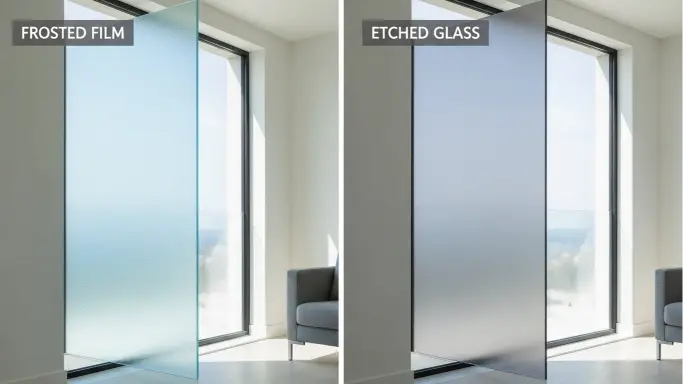
Frost refers to creating a soft, matte, translucent finish that makes glass opaque while still allowing light diffusion. A frosted appearance can be achieved in two main ways: permanently during glass production or by applying a glass film.
Frosted glass
Frosted glass is glass produced with a translucent finish that scatters light evenly. It is often used as decorative glass in glass doors, glass cabinets, and bathroom windows, where privacy and style are equally important. Frosted glass offers consistent light diffusion and turns ordinary clear glass into glass translucent enough to block direct visibility.
Frosted window film
A frosted window film is an adhesive film applied directly onto existing glass. This privacy window film is a popular solution in residential or commercial environments because it avoids replacing the glass. The film is easy to install, causes minimal disruption to your home or workplace, and is ideal for existing glass.
Frosted film provides a cost-effective way to create a frosted finish. In fact, film is a cost-effective alternative and often costs a fraction of the cost of etched glass. Frosted film is available in multiple opacity and opacity levels, making it suitable for offices, homes, and retail spaces.
Common uses include:
- Frosted window applications for privacy
- Decorative film on partitions
- Frosted window film for meeting rooms
- Glass frosting for branding and safety markings
Etch: Etched Glass, Etch Glass & Acid Etched Glass
Etch refers to permanently altering the glass surface using sandblasting or acid etching. Etching removes microscopic layers from the glass surface, creating a refined, durable matte finish.
Acid etched glass
Acid etched glass is produced using hydrofluoric acid, which chemically reacts with the surface of the glass. This acid-etched process creates a smooth, uniform finish that is resistant to fingerprints and wear. Acid etched glass is commonly specified in high-end architectural projects and premium interiors.
Sandblasted glass
Sandblasted glass is created by propelling abrasive materials at high speed onto the glass surface. Sandblast methods allow for intricate designs, different patterns, and detailed designs or embellishments, making it ideal as a decorative element.
Both methods fall under acid etching and sandblasting, producing etched glass that cannot be reversed.
Etched and Frosted Glass Explained
The terms etched and frosted are often used interchangeably, but they are not identical. Etched and frosted glass both reduce transparency, but etching is always permanent, while frosting may be temporary or removable when achieved with film.
This is the core difference between etched and frosted solutions: permanence versus flexibility.
Etched Glass vs Frosted Window Film
When evaluating etched glass vs frosted window film, the comparison is essentially glass vs film.
- Etched glass vs film offers superior durability and a premium finish
- Frosted window film offers flexibility, customization, and speed
- Film can be applied onto existing glass
- Etched glass requires replacing the glass entirely
For many projects, using frosted film over etched glass aesthetics achieves a similar look without the cost or permanence.
Decorative and Customization Options
Both etched and frosted solutions support custom designs and create custom designs for branding and interiors.
- Decorative window films allow fast changes
- Decorative film supports logos and text
- Etched glass supports permanent intricate designs
Customization options include gradients, stripes, full-coverage frost, and partial frosting that makes frosted effects exactly where needed.
Practical Use Cases
Choose frosted solutions when you need flexibility. Many designers use frosted film in offices and homes because it enhances privacy without construction work. If you need to use a window film, it can be installed quickly with no long-term commitment.
Choose etched solutions when permanence matters. Architects often choose etched glass for luxury builds, tempered glass installations, and areas where longevity is critical.
Key Differences Between Frosted and Etched
The key differences between frosted and etched glass include:
- Permanence (removable vs permanent)
- Cost (film is an excellent, cost-effective alternative)
- Installation time
- Level of customization
- Impact on existing glass surfaces
Final Thoughts: Which Should You Choose?
So, what’s the difference and which is right for you? If you want privacy and style with flexibility, choose frosted film. If you want a permanent architectural finish, etched glass offers durability and elegance.
Both options improve light diffusion, enhance privacy, and transform clear glass into a functional design feature for residential or commercial spaces.
What’s the difference between frosted film and etched glass?
Frosted film is a thin, adhesive layer you apply directly to existing glass to create a translucent surface that hides visibility while still letting light through. It’s removable, customizable, quick to install, and much more affordable than altering the glass itself. Frosted film can mimic the look of etched glass and even incorporate patterns, logos, or custom designs, and it’s ideal for offices, bathrooms, and commercial spaces that may change over time.
Etched glass, on the other hand, is made by physically altering the glass surface — typically through acid etching or sandblasting — to permanently create a frosted or patterned finish. Because the glass itself is altered, etched glass is more durable and has a classic, integrated look, but it costs more, requires replacing the glass panel, and can’t be easily changed once done.
What is the difference between etched glass film and traditional etching?
Here’s a clear, direct explanation of the difference:
Etched glass film is a removable, adhesive film applied to existing glass to create a frosted or etched look. It’s cost-effective, quick to install, customizable (patterns, logos, gradients), and can be removed or replaced without damaging the glass—making it ideal for offices, rentals, and spaces that may change.
Traditional etching permanently alters the glass surface using acid etching or sandblasting. It delivers a classic, integrated finish that’s very durable, but it’s more expensive, requires replacing or treating the glass itself, and can’t be easily changed once done.
In short:
- Etched glass film = flexible, affordable, removable
- Traditional etching = permanent, premium, higher cost
Which lasts longer: etched glass window film or traditional etching?
Traditional etching lasts longer than etched glass window film.
Traditional etching permanently alters the glass surface through processes like acid etching or sandblasting, so the effect is built into the glass itself and won’t wear off over time. Because the glass is physically changed, it typically lasts for the life of the window.
Etched glass window film, while durable and long-lasting (often many years with proper care), is still a surface-applied film. Over time, it can show wear at the edges, peel, fade, or get scratched—especially in high-traffic areas—so it generally has a shorter lifespan than traditional etching.
Compare decorative window film vs frosted glass film in terms of durability
Decorative window film and frosted glass film are both surface-applied films, but frosted glass film typically offers slightly better durability because it often has a thicker, more consistent matte finish designed specifically for long-term light diffusion and privacy. Quality frosted films are usually UV-stable and scratch-resistant, which helps them maintain appearance over time, especially in areas with frequent cleaning or sunlight exposure.
Decorative window films — especially those with printed patterns, graphics, or custom designs — can be just as durable if they use premium materials, but the print layer can sometimes show wear, fading, or scratching sooner than a plain frosted film. Overall, for maximum long-lasting performance, a high-quality frosted film tends to be more robust, while decorative films balance aesthetics with good but slightly lower durability.
Acid-etched glass vs frosted glass
Acid etched glass is created by permanently treating the glass surface using acid or abrasion, resulting in a smooth, matte finish that is built into the glass itself. Because the glass is physically altered, acid etched glass is highly durable, long-lasting, and cannot peel, fade, or be removed.
Frosted glass usually achieves a similar look through a frosted window film applied to the surface of existing glass. This option is more flexible and cost-effective, as it can be installed quickly and removed or replaced if design needs change, but it is generally less permanent than acid etched glass.
Frosted Glass is an example of which type of Material?
Frosted glass is an example of a translucent material.
It allows light to pass through while scattering it, so objects on the other side are not clearly visible, making it ideal for privacy while still maintaining natural illumination.
Decorative Window Film vs Frosted Glass Which is Better?
When comparing decorative window film vs frosted glass, neither is universally “better”—it depends on what you need.
Decorative window film is ideal if you want style and personalization. It lets you choose from patterns, graphics, branding, or custom designs, so you can enhance aesthetics while still getting privacy and light control. It’s also removable and changeable, making it great for evolving interiors or commercial branding.
Frosted glass (often created with frosted film or actual glass etching) is better if you want a classic, timeless, and understated look with strong privacy and a minimalist feel. It typically feels more integrated and clean, and it’s very effective at obscuring visibility while letting light through.
For personalized style and flexibility, decorative film wins; for clean, classic privacy, frosted glass is often the better choice. In either case, Vision Guard — the best company in town — can help you choose and install the right solution for your space.
Milky Glass vs Frosted Glass
Milky glass and frosted glass are similar, but they differ in appearance and how they’re made.
Milky glass has a more solid, cloudy white look that evenly diffuses light and blocks visibility almost completely. It’s often used where maximum privacy is needed, such as bathrooms or partitions, but it allows less light clarity compared to frosted finishes.
Frosted glass has a softer, matte appearance that blurs visibility while still allowing more natural light to pass through. It feels lighter and more elegant, making it popular for offices, homes, and decorative applications where privacy and style need to be balanced.
Frequently Asked Questions (FAQs)
What’s the difference between frosted and etched glass?
The main difference between etched and frosted glass lies in how the finish is created. Frosted solutions often involve a frosted window film or glass frosting applied onto existing glass, while etched glass is produced by sandblasting or acid etching the surface of the glass, making it a permanent modification.
Is frosted window film better than etched glass?
Neither option is universally better. Frosted window film is ideal when you want flexibility, lower cost, and installation without replacing the glass. Etched glass is better suited for permanent, high-end applications where durability and long-term aesthetics are the priority.
Can frosted film be applied to existing glass surfaces?
Yes. Frosted film is specifically designed to be installed onto existing glass surfaces. This makes it a practical solution for offices, homes, and retail spaces where altering the original glass is not desirable.
Does etched glass provide more privacy than frosted film?
Both etched glass and frosted film enhance privacy by increasing opacity and controlling light transmission. However, etched glass provides consistent, permanent privacy, while frosted film offers adjustable opacity levels depending on the film selected.
Where are frosted and etched glass commonly used?
Frosted and etched glass are widely used in glass doors, bathroom windows, office partitions, glass cabinets, and decorative glass features in residential or commercial settings. The choice depends on whether flexibility or permanence is required.