
Home › Blog › Reflective vs Nano Ceramic Window Film
Window Film · Comparison Guide
Reflective vs Nano Ceramic Window Film: Which Suits Your Building?
Both films cut the heat coming through your glass. They just do it in very different ways, and that changes how your building looks, how bright it feels inside and what you see at night.
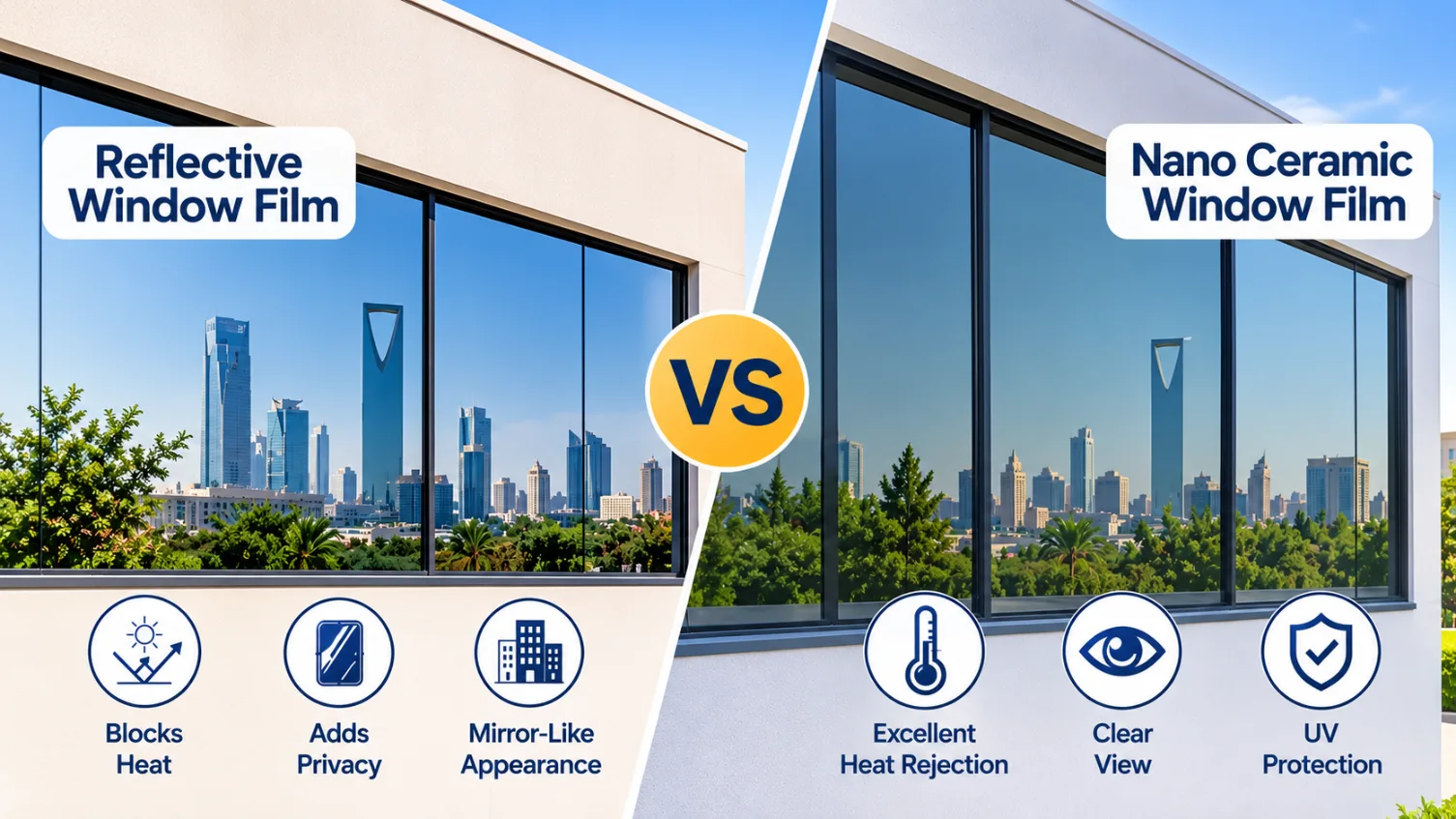
Choose reflective film when you want the most heat blocked for the money and daytime privacy, and you are happy with a mirror look outside. Choose nano ceramic film when you want to keep your view, your daylight and the normal look of the glass. Many Saudi buildings end up using both: reflective on the hot west and south sides, nano ceramic where the view matters.
Most people start this comparison with one question: which one blocks more heat? It is a fair question, but it is not the one that decides the job. The bigger questions are how much light you are willing to lose, whether a shiny facade suits the building, and what happens after sunset.
This guide compares the two using figures from our own data sheets. If you want the full detail on either film first, see our reflective window film service or our guide to nano ceramic window film.
How each film keeps the heat out
The difference starts inside the film itself.
A very thin metallised layer works like a mirror. It bounces a large share of the sun's light and heat back outside before it reaches the room. That is why the glass looks silver from the street.
Tiny ceramic particles target infrared, the part of sunlight you feel as heat, while letting most visible light pass. The glass keeps a natural look with very little shine.
Put simply, reflective film fights heat mainly by bouncing light away, so it has to be shiny and fairly dark to work at its best. Nano ceramic film is selective. It goes after the heat and leaves more of the daylight alone.
Side by side: what the data sheets say
Here are two films we fit: our Reflective Silver 20 and our Nano Ceramic 70100. They sit at opposite ends of the choice, which makes the trade-off easy to see.
| Feature | Reflective Silver 20 | Nano Ceramic 70100 |
|---|---|---|
| Visible light transmission | 20% | 69% |
| Total solar energy rejected | 70–80% | 60–70% |
| Infrared rejection | 88% | See data sheet |
| UV rejection | 99% | See data sheet |
| Look from outside | Silver mirror | Natural, low shine |
| Daytime privacy | Strong | Light |
| View out at night | Reflection of the room | Clear |
| Phone, GPS and Wi-Fi signals | Ask us to check the grade | No interference |
| Extra feature | Glare control | 8 mil safety layer, 0.42% haze |
Figures from Vision Guard product data sheets. Other shades of each film perform differently, so always compare the sheet for the exact grade you are quoted.
So reflective film wins on raw heat rejection, but it gets there by letting in less than a third of the light that nano ceramic does. In a villa majlis that can feel like a permanently cloudy afternoon. On a west-facing office facade with blinds drawn all day, it may be exactly what you want.
Darker does not always mean cooler
A dark film is not automatically a cool film. The number that tells you how much heat a film stops is total solar energy rejected (TSER), not how dark it looks. Our guide on sun control film and TSER explains how to read it.
Not sure which side wins for your windows?
Send us a photo of each side of the building. We will tell you where reflective makes sense and where nano ceramic does.
When reflective film is the better choice
Reflective film earns its place on glass that takes the full force of the sun, where light and view matter less than comfort and privacy. It suits:
- West and south facades on offices and commercial towers, where afternoon sun overheats whole floors
- Villa windows that face the street or a neighbour, where you want privacy during the day
- Large glass areas where the owner wants one even, uniform look across the building
- Warehouses, stairwells, skylights and service areas where nobody needs a view
- Projects where the budget has to stretch over a lot of glass
If the building is in Riyadh, our page on reflective window film in Riyadh covers shades and local installation. For privacy on glass that people walk past all day, it is also worth reading about one way vision film.
When nano ceramic film is the better choice
Nano ceramic film is the pick when the glass is there for a reason: the view, the daylight, or the display behind it. It suits:
- Living rooms and majlis glass with a garden, pool or city view you want to keep
- Shopfronts and showrooms, where customers need to see the products clearly
- Clinics, schools and offices that rely on natural daylight through the working day
- High-floor apartments, where privacy from the street is not the issue but heat is
- Buildings with strict looks, where a mirrored facade would stand out
- Rooms full of phones, routers and smart devices, since there is no metal layer to block signals
Our main window film service in Saudi Arabia is built around nano ceramic grades. If the same glass also needs to hold together when it breaks, the 8 mil Nano Ceramic 70100 does both jobs, as explained in our safety film thickness guide.
The night-time question most buyers forget
This is where many people get a surprise after installation, so it is worth being clear.
Reflective privacy flips after dark
The mirror effect works toward the brighter side. In the day, outside is brighter, so people outside see a mirror. At night, with your lights on, people outside can see in. You will still need curtains or blinds in bedrooms and the majlis.
You may see yourself instead of the view
At night, a reflective film can show you a reflection of the room rather than the street or garden outside. If you enjoy the evening view from your windows, this matters.
Nano ceramic gives no real privacy
It keeps the glass close to clear, day and night. If privacy is the main goal and the view is not, nano ceramic alone will not solve it.
Check your glass before you choose
The film has to suit the glass, not only the room. Any film that absorbs sunlight heats the glass, and if the centre of a pane gets much hotter than its edges, it can crack. This is called thermal stress. Tempered glass handles it well. Ordinary float glass, large panes and double-glazed units need checking first.
Glass type
Single, tempered, laminated, tinted or double glazed. Each one has limits on which film grades are safe.
Which way it faces
West and south glass in Saudi Arabia takes the most sun, so it carries the most heat load and the most risk.
Size and shading
Very large panes, or glass half in shadow from a balcony, heat unevenly. Blinds pulled tight against the glass add to it.
Building rules
Some towers, compounds and landlords control how the facade looks. Check before you put a mirror finish on a shared front.
We check every pane during the survey and match the film to the glass maker's and film maker's guidance. If a grade is not safe for your glass, we will tell you and suggest one that is.
Which film fits your building?
| Building or room | Main goal | Usually recommended |
|---|---|---|
| Villa windows facing the street | Heat plus daytime privacy | Reflective |
| Villa living room or majlis with a view | Heat, keep the view | Nano ceramic |
| Office tower, west or south facade | Maximum heat cut, uniform look | Reflective |
| Office with open-plan desks | Daylight and comfort | Nano ceramic |
| Shop, showroom, mall unit | Keep displays visible | Nano ceramic |
| Clinic, school, nursery | Daylight, plus safety on low glass | Nano ceramic, 8 mil safety grade where needed |
| High-floor apartment | Heat, keep the view | Nano ceramic |
| Warehouse, stairwell, skylight | Heat at the lowest cost | Reflective |
A starting point only. The survey confirms glass type, sun exposure and building rules before we recommend a grade.
You do not have to pick just one
On many villas and offices the best result is a mix. Reflective goes on the glass that bakes in the afternoon sun. Nano ceramic goes on the sides with the view, the entrance or the shop window. You get strong heat control where it counts and a natural look where people notice it.
What decides the price of your job
There is no single price per film type, because no two buildings are the same. These are the things that move your quote up or down:
Film grade
Reflective film is often the lower-cost option. Nano ceramic and safety grades cost more per square metre.
Total glass area
The more square metres you cover, the lower the cost per metre usually becomes.
Height and access
Ground-floor windows are quick. High facades and atriums may need ladders, scaffolding or a lift.
Inside or outside fit
Most film goes on the inside face. Exterior fitting takes more preparation and suitable grades.
Old film removal
If tired or bubbling film is already on the glass, it has to come off cleanly before new film goes on.
Glass condition
Scratched glass, damaged seals or odd shapes take extra time to prepare and cut.
Mixing both films on one building does not make the job more complicated. Each area is simply priced at its own grade.
Want a quote? Send us these five things
You can get a first estimate without waiting for a visit. Send these on WhatsApp and we will come back with a recommendation for each area:
- Photos of the windows, from inside and outside
- Rough width and height of each window, or the total area
- Which way the glass faces, if you know
- What bothers you most: heat, glare, privacy or the view
- The building type and floor, plus your district or city
We confirm the final figure after checking the glass on site.
Our Riyadh team covers every district of the city and also takes jobs in other Saudi cities, including Dammam, Al Khobar and Jeddah.
How we help you decide
Look at the glass
Type, size, frame and which way each pane faces.
Ask what bothers you
Heat, glare, privacy, the view, or a mix of these.
Compare options
We explain which film suits each side of the building, and why.
Written quote
Film name, grade and data sheet for each area.
Install and cure
Film may look slightly hazy at first while it dries.
See both films on your windows first
Seeing your own glass in your own light tells you more than any table. For homes and offices in the capital, see our window film installation in Riyadh, or contact us to book a visit anywhere we cover.
Frequently asked questions
Which blocks more heat, reflective or nano ceramic film?
Comparing our own grades, Reflective Silver 20 rejects 70–80% of total solar energy and Nano Ceramic 70100 rejects 60–70%. Reflective film blocks more, but it also lets in far less daylight: 20% against 69%.
Can people see inside through reflective film at night?
Yes, when your lights are on and it is dark outside. The mirror effect only works toward the brighter side, so you still need curtains or blinds at night.
Does nano ceramic film make the room dark?
Not much. Our Nano Ceramic 70100 lets through 69% of visible light, so rooms stay bright and the view stays clear.
Will window film affect my phone or Wi-Fi signal?
Nano ceramic film has no metal layer, so it does not interfere with phone, GPS or Wi-Fi signals. Some metallised reflective films can weaken signals, so ask us to check the exact grade if signal matters in that room.
Can I put film on double-glazed windows?
Usually yes, but not every grade suits every unit. Darker, more absorbing films raise the risk of thermal stress, so we check the glass before recommending a film.
Which film is cheaper?
Reflective film is often the lower-cost option per square metre. Your final price depends on the grade, total glass area, height and access, and the condition of the glass. Send us photos for a first estimate, and we confirm the written quote after the survey.
Still deciding between the two?
Vision Guard checks each window, explains how each film would look and perform there, and recommends the right one for every side of the building. Book a site survey, or send us photos of your windows on WhatsApp.