
Home › Architectural Services › Decorative Film › Decorative Window Film Ideas for Offices
Decorative Film · Office Design Guide
Decorative Window Film Ideas for Offices in Saudi Arabia
Glass partitions look sharp on day one and awkward by week two, once every meeting is visible from the corridor. Decorative film fixes that without rebuilding a single wall. Here are the design directions that work in a Saudi office fit out, and how to match each one to the right zone.
Decorative window film is a printed or textured self adhesive film applied to existing office glass to add privacy, branding and pattern without replacing the glazing. The ideas that work best in a Saudi office are manifestation banding on full height partitions, a printed logo or wordmark on the reception glass, gradient film that shades the lower half of a meeting room, geometric or mashrabiya inspired patterns on breakout areas, reeded and fluted effects on executive offices, and custom printed graphics on internal corridors. Film is cut to each pane, installed in a working office within a day or two, and can be changed later when the branding changes.
Most Saudi offices built in the last decade run on glass. Partitions, meeting rooms, executive suites and reception fronts are all glazed, which is excellent for daylight and terrible for concentration. The usual reaction is to order blinds, which block the light the architect fought for, or to swap in solid walls, which costs far more than the problem is worth.
Decorative film sits between those two extremes. It is applied to the glass you already own, it can be as subtle as a frosted band at eye level or as loud as a full wall graphic, and it comes off cleanly when the tenancy or the brand changes. Our full decorative film service covers specification, printing and installation across the Kingdom.
What Decorative Window Film Actually Is
Decorative film is a polyester based adhesive film, usually between 50 and 100 microns thick, bonded to the internal face of the glass. It carries a finish rather than a performance coating: a sandblast effect, a printed design, a colour, a gradient or a moulded texture.
That distinction matters when you are specifying. Sun control and heat rejection are the job of window film, switchable privacy on demand is the job of smart film, and plain permanent obscurity is usually handled by a frosted glass sticker. Decorative film is the layer you choose when the glass has to carry a design intent as well as a function.
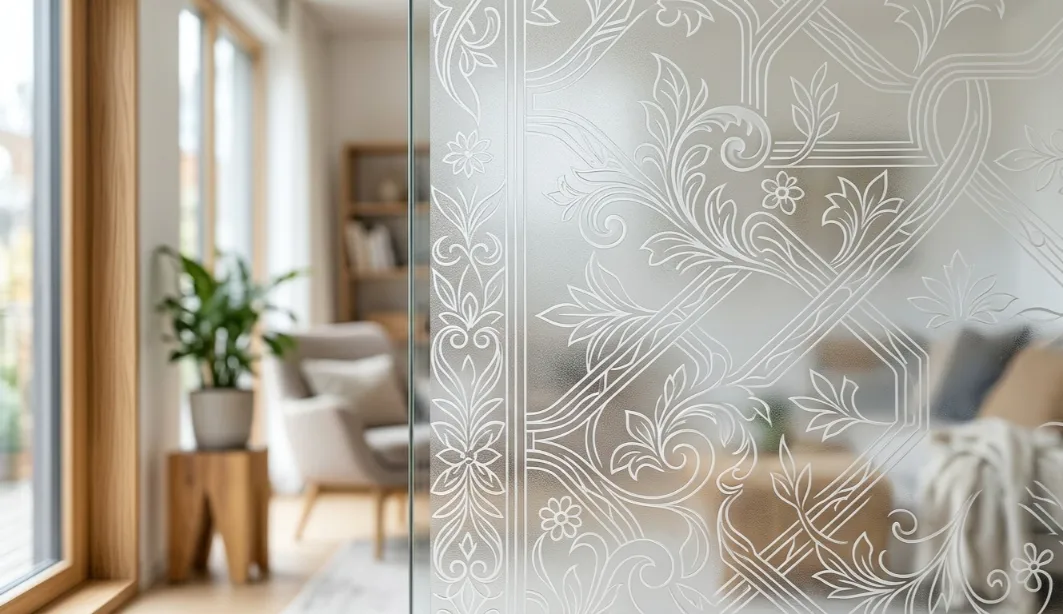
Four of the most requested decorative finishes for office glazing. All are applied to existing panes.
Ten Decorative Window Film Ideas for Office Glass
Each of these has been specified repeatedly on commercial fit outs, and each solves a different problem.
Manifestation banding
A horizontal frosted band at roughly eye level across full height glazing. It marks the glass so nobody walks into it, and it screens seated sightlines at the same time.
Printed logo on reception glass
The wordmark cut or printed directly onto the entrance screen. It is the cheapest branded moment in the building and the first thing a visitor reads.
Gradient privacy
Dense at the bottom, clear at the top. Desks and laptops are screened, the ceiling line and daylight stay open. Ideal for open plan meeting pods.
Geometric and mashrabiya patterns
Repeating lattice patterns that read as architecture rather than signage, and give a Saudi fit out a regional identity instead of a generic corporate one.
Reeded and fluted effect
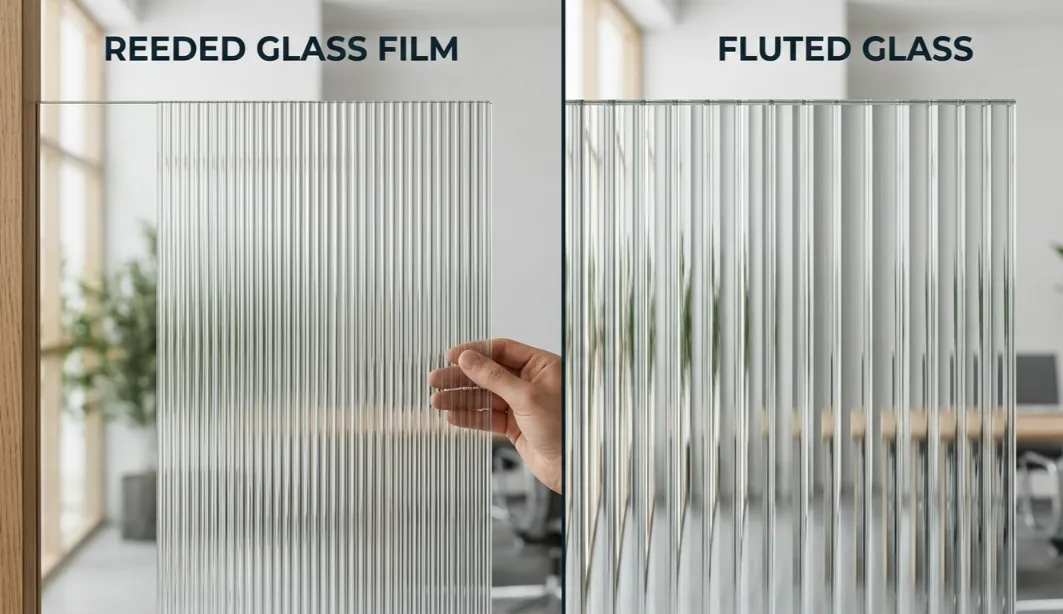
Vertical ribbing that distorts shapes without blocking light. It suits executive offices and directors' rooms where presence matters more than total concealment.
Wayfinding and room numbering
Room names, floor numbers and department labels applied straight to the glass, so the signage budget disappears into the partition system.
Full wall printed graphics
Photographic or illustrated murals across a corridor or breakout wall. Useful where a blank internal glazed run has no view worth keeping.
Coloured and tinted panels
Solid or translucent colour used to zone a floor plate, matched to the brand palette rather than to a stock glass tint.
Whiteboard and writable film
A dry wipe surface applied to a glass wall, turning a meeting room partition into a working surface without hanging a board on it.
Cut vinyl lettering
Values, mission lines or Arabic calligraphy cut from film and weeded, so only the letterforms sit on the glass with no visible background panel.
Decorative Film Types Compared
Use this to narrow the specification before a survey.
| Film Type | Visual Effect | Privacy Level | Light Loss | Best Used On |
|---|---|---|---|---|
| Sandblast / etch effect | Uniform matt white | High | Low | Meeting rooms, manifestation bands |
| Printed graphic | Full colour design | Medium to high | Varies with ink coverage | Reception, corridors, feature walls |
| Gradient | Fading density | Medium at seated level | Very low | Open plan pods, glazed offices |
| Reeded / fluted effect | Vertical ribbed distortion | Medium | Very low | Executive suites, hospitality areas |
| Coloured translucent | Tinted wash of colour | Low to medium | Medium | Zoning, brand accent panels |
| Cut vinyl lettering | Letterforms only | None | None | Signage, wayfinding, glass doors |
Where a room needs privacy that can be switched off rather than designed in, the specification moves away from decorative film altogether. That is a switchable glass conversation, not a print one.
Key point
Decorative film changes how glass looks, not how much heat it stops. If a glazed elevation is uncomfortable in the afternoon, the film that solves it is a solar control product, and it can be specified alongside the decorative layer rather than instead of it.
Manifestation: the Safety Job Decorative Film Quietly Does
Large areas of clear, full height glazing are difficult to see, and walk in incidents are a genuine risk in offices, clinics and showrooms. Marking that glass so it is visible to anyone approaching it is a standard requirement in commercial fit out practice, and decorative film is the normal way it is delivered.
The practical rule of thumb used on most projects is a marking that is clearly visible to both a standing adult and a seated one, applied consistently across every pane in the run. A plain safety dot satisfies the requirement. A patterned band, a logo repeat or a gradient satisfies it and looks deliberate, which is why most designers fold the safety marking into the decorative scheme rather than treating it as a separate item.
Matching Film to Each Office Zone
The most common specification mistake is applying one finish to every pane in the building. Different zones want different things.
Installation, Timelines and Aftercare
Every pane is measured individually, because partition systems rarely deliver identical glass across a floor. Printed and cut designs are then produced to those measurements, so the artwork lines up across mullions rather than being trimmed on site.
Installation is wet applied, which means the glass is cleaned, the film is floated into position, and the solution is squeegeed out. The film reaches full clarity as the residual moisture dries, typically over the following days. Work is normally scheduled outside business hours on occupied floors, and a single meeting room is usually a same day job.
Aftercare is straightforward. Clean with a soft cloth and a non abrasive glass cleaner, avoid scrapers and ammonia heavy products on printed surfaces, and the finish holds for years on internal glazing. Because the film is removable, a rebrand means reprinting one layer rather than replacing partitions. If you are planning a fit out, the wider architectural services range covers the sun control and privacy layers that usually get specified at the same time.
Written by the VissionGuard Architectural Team, based in Al Malaz, Riyadh. We survey, print and install decorative, privacy and solar control film on offices, clinics, showrooms and villas across Saudi Arabia. This guide reflects how these finishes are specified and installed on live commercial projects.
Frequently Asked Questions
What is decorative window film used for in offices?
Decorative window film is used to add privacy, branding, pattern and safety marking to existing office glass. Common applications are manifestation banding on full height partitions, printed logos on reception screens, gradient privacy on meeting rooms and open plan pods, and full colour graphics on internal corridor glazing.
Does decorative film block heat or UV?
Not meaningfully. Decorative film is specified for appearance and privacy, so heat and glare on a sun exposed elevation should be handled with a solar control window film instead. The two can be used together on the same project, with the decorative finish on internal partitions and the solar product on the external glazing.
Can decorative window film be removed later?
Yes. Decorative film is designed to be removable, which is one of the main reasons tenants choose it over sandblasted or laminated glass. It can be lifted and replaced when a brand changes or a lease ends, leaving the original glass intact when it is removed correctly.
Can you print a custom design or Arabic calligraphy onto the film?
Yes. Custom artwork, brand patterns, photographic images and Arabic calligraphy can all be printed or cut from film and applied to the glass. Artwork is set out pane by pane so that a design running across several panels aligns correctly once installed.
How long does a decorative film installation take?
A single meeting room or reception screen is normally completed within a day. A full floor of partitions takes longer and is usually scheduled in phases or outside working hours, with the exact programme confirmed after the site survey and measurement stage.
Plan Your Office Glass Design
VissionGuard surveys, prints and installs decorative film for offices across Saudi Arabia. Book a site survey or send your floor plan for a quotation.