
Switchable glass, also known as smart glass or privacy glass, is transforming the way we interact with architecture, vehicles, and interiors. At Vision Guard, we believe in providing innovative, energy-efficient, and futuristic glass solutions. But how exactly does smart glass work? Let’s dive into the fascinating science behind this advanced technology.
Smart glass works by using electricity to change how a layer inside the glass handles light. In the most common type, PDLC, microscopic liquid crystal droplets sit scattered at random inside a clear polymer. With no power applied, those droplets point in every direction, scatter the light passing through, and the glass looks frosted. Applying a low voltage lines the droplets up in one direction; their refractive index then matches the polymer around them, and light passes straight through, so the glass turns clear. The change takes well under a second and reverses the moment the power is cut.
This guide explains the mechanism layer by layer, compares the four smart glass technologies in commercial use, and sets out what the physics means for a building in Saudi Arabia. Almost every project in the Kingdom takes the retrofit route, where smart film installation is carried out on glass that is already glazed and occupied.
What is Switchable Smart Glass?
Smart glass is any glazing whose light transmission can be changed on demand, either electrically or in response to its environment. Switchable smart glass is the electrically driven half of that category, and electronic glass technology is the umbrella term the manufacturing industry uses for it. The category splits cleanly in two.
- Active smart glass is switched by electricity and gives the user direct control. PDLC, SPD, and electrochromic glass all sit here.
- Passive smart glass reacts on its own to an external trigger. Photochromic glass darkens in sunlight, and thermochromic glass responds to temperature, with no switch and no wiring.
The terminology is unusually messy. Switchable glass, switchable glazing, privacy glass, electric glass, and smart window technology are all used in the same category, and in commercial contexts they almost always refer to the active kind, usually PDLC specifically. That is the technology this guide focuses on because it is used in the vast majority of architectural privacy installations.
What Is Inside a Sheet of Switchable Glass?
Smart glass windows are advanced glass systems that can change their transparency or tint on demand. Using technologies like PDLC (Polymer Dispersed Liquid Crystal), electrochromic, or suspended particle devices, the glass can switch from clear to opaque or tinted with the press of a button, a remote control, or through smart home automation.
They are used to control privacy, light, and heat without curtains or blinds and are commonly installed in offices, homes, hospitals, and commercial buildings. Smart glass windows improve comfort, energy efficiency, and modern design by allowing users to adjust visibility and sunlight whenever needed.
A PDLC panel is a sandwich. Working from the outside in, the stack looks like this.
Glass or PET carrier | Outer face, the surface you touch |
Transparent conductive layer | Usually indium tin oxide, the electrode |
PDLC layer | Liquid crystal droplets in a polymer matrix |
Transparent conductive layer | The second electrode |
Glass or PET carrier | Inner face, bonded to the pane |
The two conductive layers are the reason the panel can be switched at all. They are thin enough to see through but conduct well enough to create an electric field across the film between them. Everything interesting happens in the middle layer.
That middle layer is not a liquid sloshing about. During manufacture, liquid crystal is mixed with a prepolymer, and the mixture is then cured, usually under ultraviolet light. As the polymer forms, the liquid crystal separates out into millions of droplets a few microns across, permanently locked inside the polymer network. The film stays solid, flexible, and cuttable.
Types of Smart Glass Technology
There are several types of smart glass based on the technology used to change transparency:
1. Electrochromic Smart Glass
This type changes its tint when an electrical voltage is applied. It doesn’t require continuous electricity—only a small voltage during the switching process. Ideal for smart windows in homes and offices.
2. PDLC (Polymer Dispersed Liquid Crystal) Smart Glass
PDLC smart glass switches from transparent to opaque with an electrical charge. When the power is on, the liquid crystals align, making the glass clear. When off, they scatter light, making it frosted or opaque. Best for privacy glass partitions, bathrooms, and meeting rooms.
3. Thermochromic Glass
This smart glass reacts to heat or temperature changes, making it suitable for climates with high sun exposure.
4. Photochromic Glass
It darkens automatically under UV rays, similar to transition lenses. This is commonly used in eyewear and is now evolving into architectural applications.
Why Does Smart Glass Look Frosted When It Is Off?
Let’s focus on PDLC smart glass, the most widely used type of switchable privacy glass:
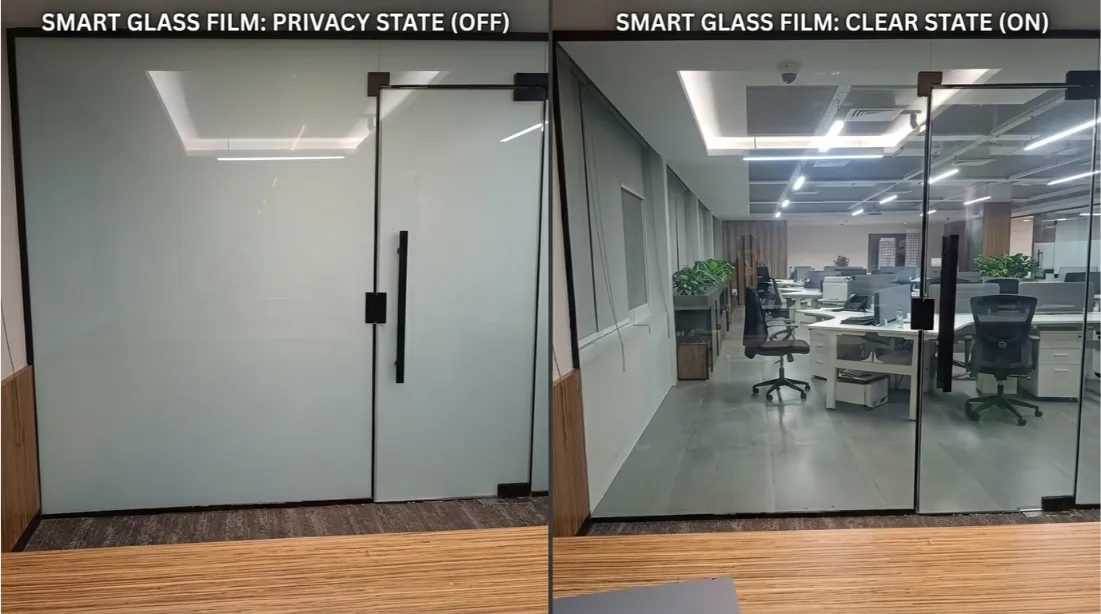
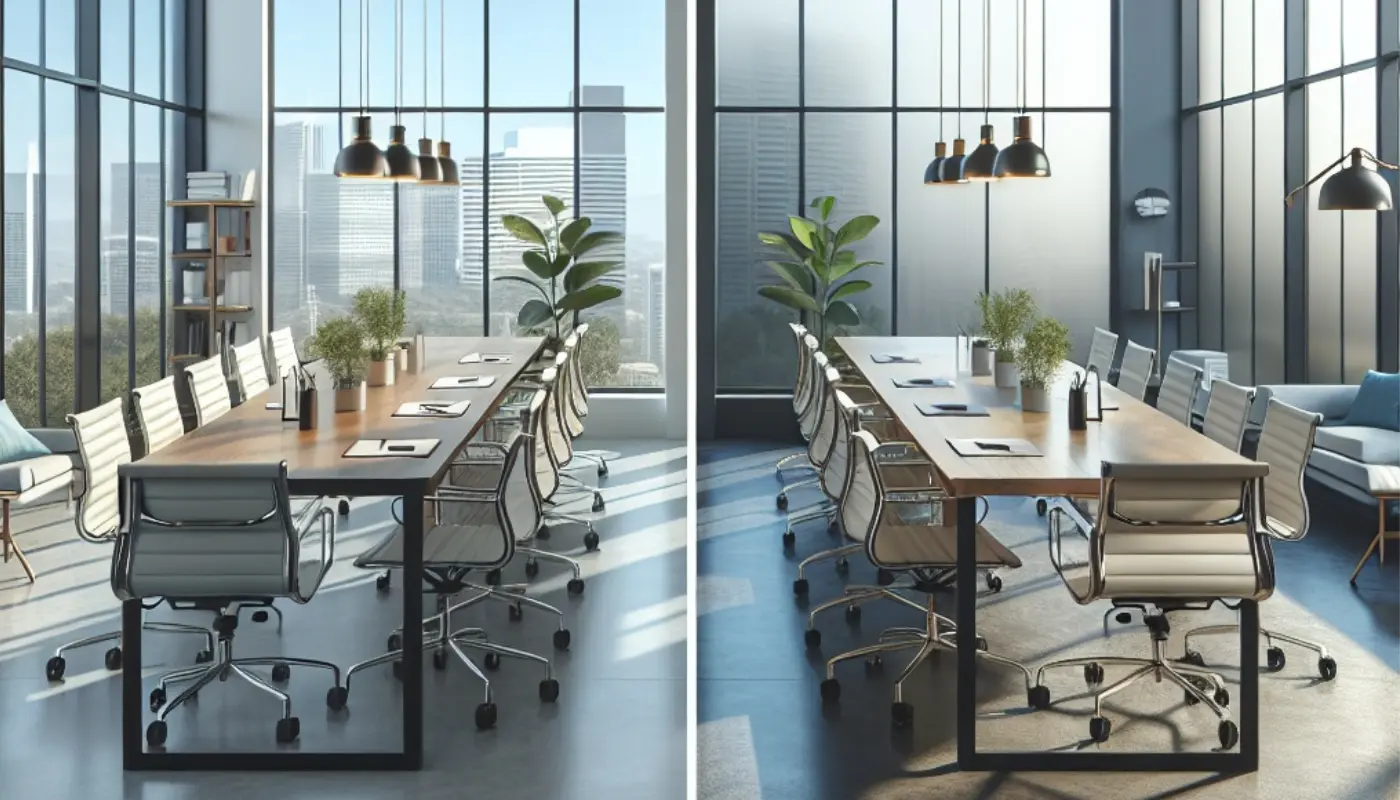
OFF State (No Power): Liquid crystals are randomly oriented, scattering light, and the glass appears frosted.
ON State (Power Applied): Liquid crystals align, allowing light to pass through, and the glass becomes clear.
This transition takes just milliseconds, offering instant privacy and light control.
Liquid crystal molecules are rod shaped, and a rod bends light differently depending on which way it is facing. This property is called birefringence, and it is the whole basis of the effect.
With no voltage across the film, nothing is holding those rods in position, so each droplet settles at its own random angle. Light entering the film hits thousands of droplets in sequence, and at every boundary between a droplet and the surrounding polymer it meets a mismatch in refractive index. Each mismatch deflects the ray slightly.
Multiply that by the number of droplets in the light path and the beam leaves the panel travelling in many directions at once. Your eye cannot resolve an image through it, so the surface appears milky white. Critically, the light is not blocked, only redirected. That is why a switched-off panel still floods a room with daylight while giving complete visual privacy.
This also explains a property that matters on site: the frosted state is the default. If the building loses power, switchable partitions fail to private rather than to clear, which is exactly the behaviour a clinic or a boardroom wants.
How Does Smart Glass Work When the Power Is On?
Applying a voltage across the two conductive layers creates an electric field through the PDLC layer. Liquid crystal molecules are dielectrically anisotropic, meaning they respond to that field by rotating until they line up with it.
Once every droplet is pointing the same way, the film presents a single, uniform refractive index along the direction the light is travelling. PDLC film is formulated so that this aligned value matches the refractive index of the polymer matrix as closely as possible. With the mismatch gone, there is nothing left at the droplet boundaries to deflect the light, and the ray passes through undisturbed. The panel turns clear.
Two consequences follow directly from this. First, clarity is a matter of degree: the more completely the droplets align, the less residual haze remains, which is why film grade and drive quality show up as visible differences in the transparent state. Second, the alignment is not permanent. Cut the power, and thermal motion randomises the droplets again within milliseconds, returning the panel to a frosted state.
Key point
Smart glass does not consume power to stay frosted. It consumes power to stay clear. Over a working day where partitions are private most of the time, that makes the running cost far lower than most people assume.
Why Smart Glass Windows Need AC Power, Not DC
This is the part of the technology most guides leave out, and it is the single biggest determinant of how long an installation lasts.
A PDLC film can be made to switch with direct current. The problem is what direct current does over time. A constant field in one direction drives ionic impurities within the film toward one electrode, and it induces a memory effect in which the liquid crystals no longer relax fully back to their random arrangement when the power is removed. The symptom is a panel that stops going properly frosted, and then a panel that stops switching cleanly at all.
Every properly engineered installation therefore uses an alternating drive. The transformer or controller supplies an AC waveform, typically in the region of 50 to 60 Hz, so the field reverses constantly and no net ionic drift builds up. When a switchable partition yellows, clouds or develops dead patches within a couple of years, an inadequate driver is a far more likely cause than the film itself.
Controllers also make dimming possible. Because alignment is proportional to field strength, a controller that varies the applied voltage can hold the panel at intermediate haze levels rather than only fully clear or fully frosted. Not every grade of switchable glass film will hold a stable intermediate state, so the film and the controller have to be specified as a pair rather than chosen separately.
Does Smart Glass Block Heat?
Not to any meaningful degree, and it is worth being direct about that.
Because PDLC scatters light rather than absorbing or reflecting it, most of the solar energy hitting the panel still ends up inside the room. The scattering is predominantly forward scattering, so the energy simply arrives diffused instead of focused. A frosted PDLC partition will cut glare noticeably and will block the great majority of ultraviolet, but it is not a solar control product and should never be sold as one.
In the Saudi climate, this matters. Glass on a west or south elevation taking direct afternoon sun needs a spectrally selective or sun control window film chosen on its TSER figure, and switchable film specified for the interior partitions where privacy is the actual requirement. The two products solve different problems and are frequently used on the same project.
Where Smart Window Technology Pays Off in Saudi Buildings
Understanding the mechanism makes the right applications obvious. Switchable glass earns its place wherever a space needs to alternate between open and private without losing daylight.
Boardrooms and meeting rooms.
Glass partitions that read as open plan until a session starts, then turn private instantly with no blinds to maintain.
Clinics and consultation rooms.
Privacy without fabric, which removes a cleaning and infection control problem rather than adding one.
Villa majlis and street-facing ground floors.
Full privacy on demand while the room keeps its natural light, which curtains cannot offer.
Hotel suites and bathrooms.
A premium feature that reduces the amount of solid partition a designer has to build.
Retail frontage.
Clear for display through trading hours, private after closing.
Sun control, safety, decorative and one way vision films are routinely specified on the same floors as switchable glass, which is why architectural glass film services are surveyed as one package rather than product by product.
How Switchable Glass Works in Five Steps
1. Droplets
Liquid crystal is dispersed as micron-scale droplets inside a cured polymer matrix.
2. Off
Unpowered, the droplets sit at random angles and scatter light, so the panel is frosted.
3. Field
An AC voltage across two transparent electrodes creates a field through the layer.
4. On
Droplets align, refractive indices match, and light passes through unscattered.
5. Reset
Remove the power, and thermal motion randomises the droplets again in milliseconds.
The physics is identical in every installation. What changes from one job to the next is film grade, control method, and room type, and each of those is set out in the complete guide to smart film.
FAQs
Does smart glass need power to stay clear?
Yes. Smart glass is transparent only while voltage is applied and returns to its frosted state as soon as the power is removed. The frosted state is the default, so a power cut leaves partitions private rather than exposed, and running costs stay low in spaces that are private for most of the day.
How expensive is switchable glass?
Switchable glass is priced per square metre, and the total depends on the glass area, the film grade, whether the job is laminated or a retrofit, and the control system specified. Because those variables move the figure considerably, Vision Guard quotes in writing after a free site survey rather than publishing a rate that would not hold.
What are the disadvantages of smart glass?
There are three real ones. It provides privacy rather than solar control, so it does not replace a heat-rejection film on sun-facing glass. It carries a residual haze in the clear state that varies by film grade, so it is never quite as optically pure as plain glass. And it depends on a controller, which means a wiring route and a component that can fail, unlike a blind.
How does smart glass get power?
It runs on low voltage from a small transformer connected to your building’s regular power supply, using about the same energy as one LED bulb.
Why does some smart glass go cloudy after a year or two?
The usual cause is an inadequate driver rather than the film. A direct current supply drives ionic drift within the layer and leaves a memory effect that stops the crystals from relaxing fully, so the panel gradually loses its ability to switch cleanly. A correctly specified AC controller prevents this.
See Switchable Glass Working in Person
Vision Guard surveys the glass, specifies the correct film grade and controller, and installs across Saudi Arabia. Book a free site survey or send us the dimensions for a written quotation.